Timeline of LGBT+ History for Stoke-on-Trent and Staffordshire
1988 – Clause 28 Bans the “Promotion of Homosexuality”
We would love to hear from anyone who can help us add to this post. Please share your memories using use the form at the bottom of this page or contact us.
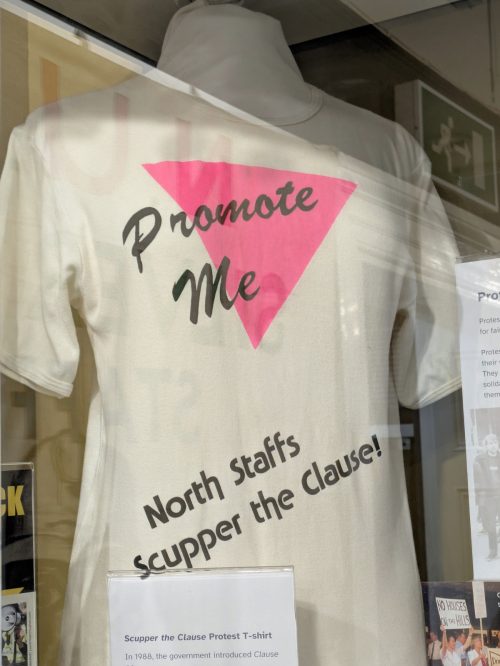
North Staffs Scupper the Clause Tee Shirt At the Brampton Museum “Voices Unheard” Exhibition 2026
In 1988 a new section was added to the Local Government Act 1986 banning the promotion of homosexuality. This came into law on 24 May 1988 and had significant national and local impact. Progress on the inclusion of homosexuality in schools sex and relationship education was effectively banned. Council funded arts and community groups deemed to be presenting homosexuality in a positive way came under threat. Generations of young LGBT+ people were adversely affected by this public stigmatisation of homosexuality, but it also fanned the flames of activism as the LGBT+ community united in protest.
Section 2A of the Local Government Act 1986 became infamously known as Clause 28; it stated:
Prohibition on promoting homosexuality by teaching or by publishing material
(1) A local authority shall not—
(a) intentionally promote homosexuality or publish material with the intention of promoting homosexuality;
(b) promote the teaching in any maintained school of the acceptability of homosexuality as a pretended family relationship.
Shortly after Clause 28 became law, The LGBT community in Stoke staged a public demonstration which the Evening Sentinel newspaper described as “the first ever gay demonstration in the Potteries”.
In this post we present clippings from archives of The Evening Sentinel newspaper published in 1988
Concerns Raised Before Clause 28 Becomes Law
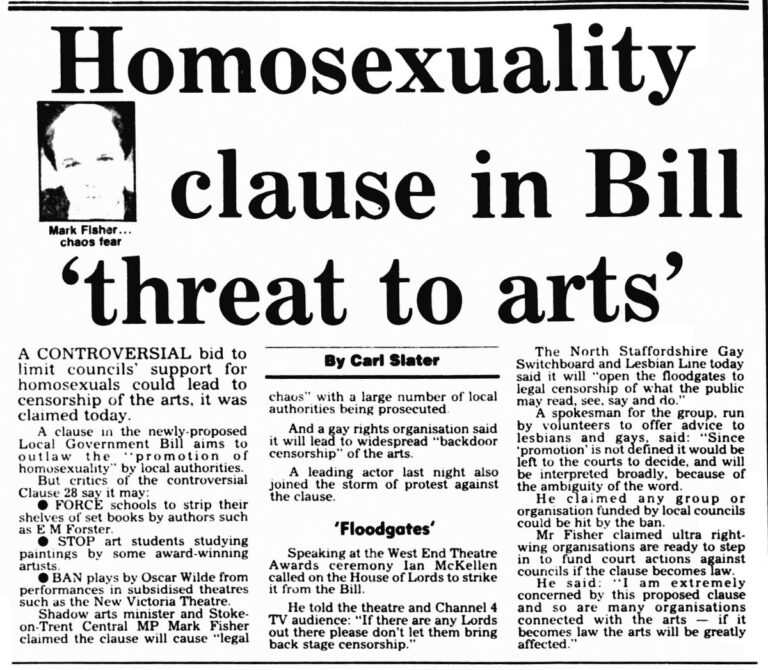
Labour MP Mark Fisher Writes of His Concerns (Staffordshire Sentinel 25 Jan 1988)
On January 25, 1988, The Sentinel reported on a “storm of protest” regarding the government’s controversial bid to ban the “promotion” of homosexuality by local authorities. Stoke-on-Trent Central MP and Shadow Arts Minister Mark Fisher warned that the proposed Clause 28 would cause “legal chaos” and lead to widespread “backdoor censorship” of the arts.
Critics specifically feared the legislation would:
FORCE schools to remove books by authors such as E.M. Forster from their libraries.
STOP art students from studying paintings by certain award-winning artists.
BAN plays by Oscar Wilde from being performed at subsidised venues, such as the New Victoria Theatre.
The North Staffordshire Gay Switchboard and Lesbian Line also raised concerns, stating the clause’s vague wording would “open the floodgates to legal censorship” of what the public could see and do; any group funded by local councils – including those providing vital advice and support – could be “hit by the ban”.
A Threat to the Arts
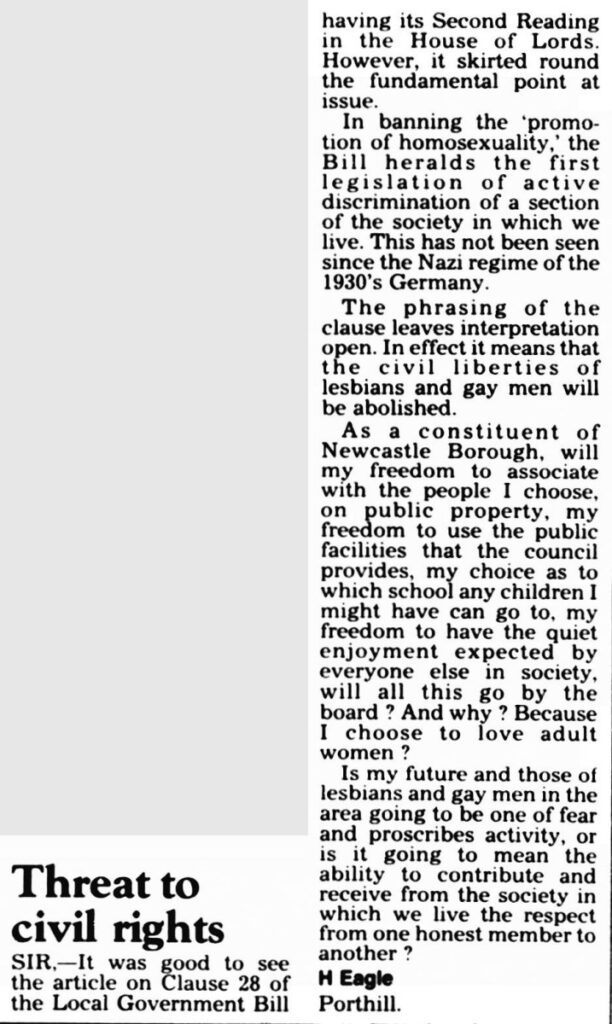
Evening Sentinel 17th Feb 1988 – A Letter of Concern
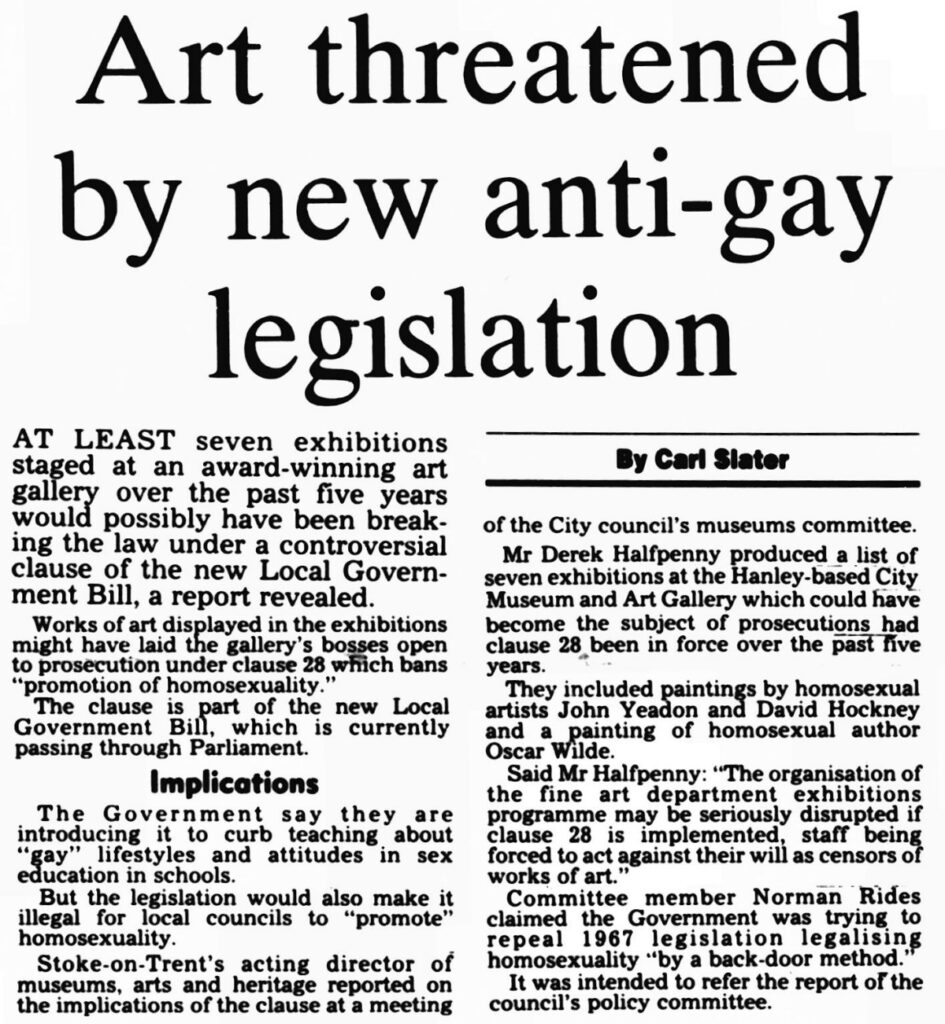
Evening Sentinel 1st March 1988 – The Director of Museums and Arts Raises Concerns
In a letter to The Sentinel, a resident from Porthill decried the bill as a “threat to civil rights,” comparing its discriminatory nature to the Nazi regime of the 1930s. The author expressed a deep fear that the vague phrasing of the clause would abolish the civil liberties of lesbians and gay men, potentially stripping them of their freedom to use public facilities and associate with others simply because of who they chose to love.
A report by the acting director of museums revealed that seven past exhibitions – including works by celebrated artists David Hockney and John Yeadon, and a portrait of Oscar Wilde—could have faced prosecution had the law been in effect. Officials warned that the city’s arts programme would be “seriously disrupted” if staff were forced to act as censors, while committee members described the clause as a “back-door” attempt to repeal the 1967 legislation that had partially decriminalised male homosexuality.
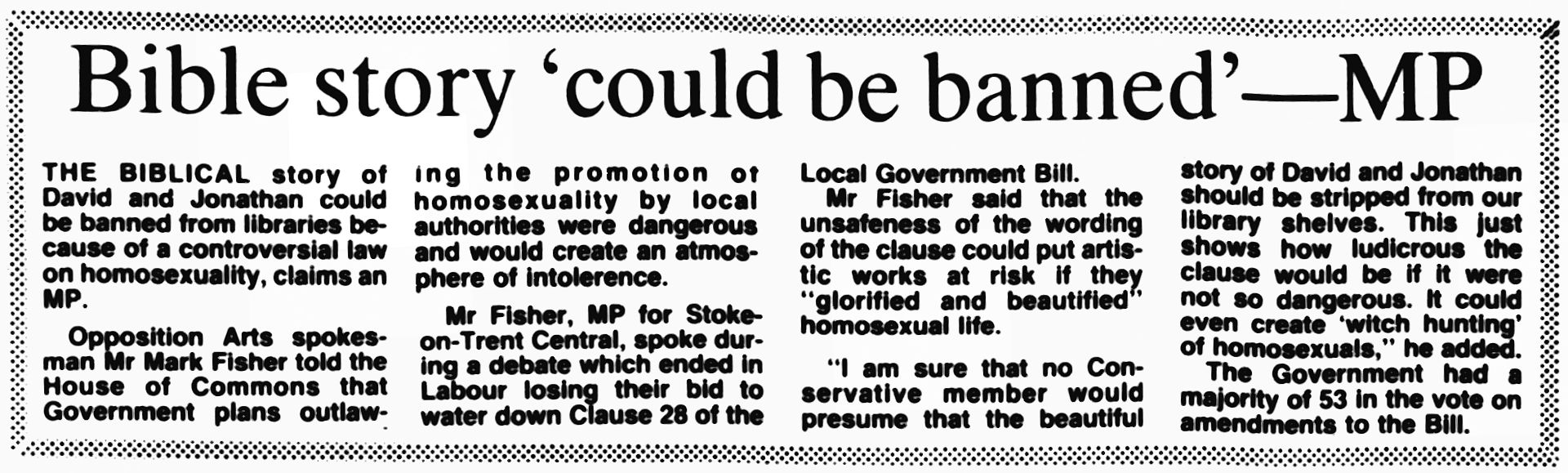
Labour MP Mark Fisher raises concerns that the biblical story of David and Jonathon could be subject to censorship under Clause 28 (Evening Sentinel 11 March 1988)
First Ever Gay Demonstration in the Potteries
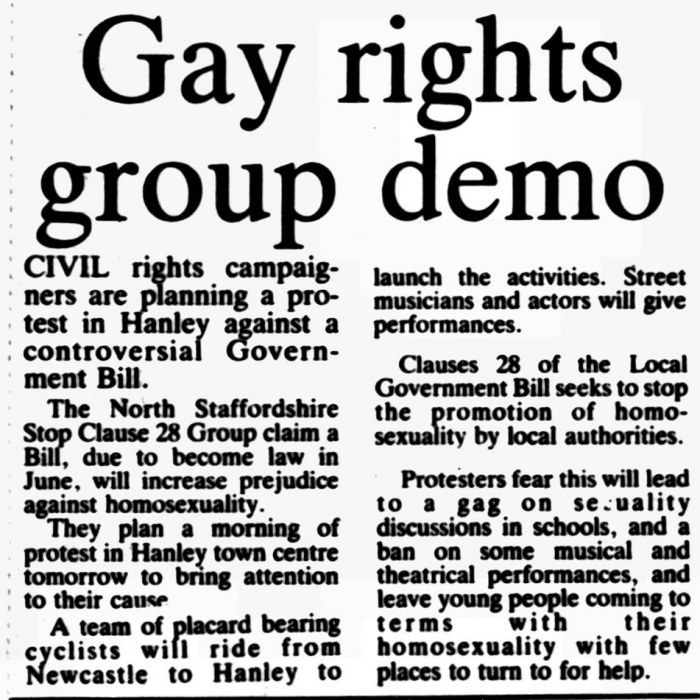
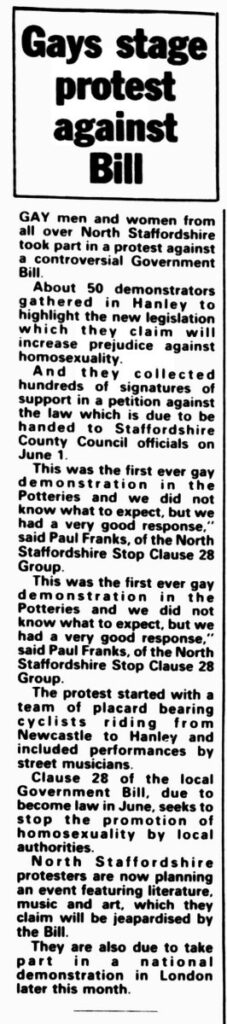
Articles in the Staffordshire Sentinel 8th Apr 1988 and 12th April 1988
The North Staffordshire Stop Clause 28 Group organised the first ever gay demonstration in the Potteries which took place in Hanley on 9th April 1988. The demonstration featured a creative and visible presence in the city, beginning with a team of placard-bearing cyclists who rode from Newcastle to Hanley. In Hanley town centre, the event included performances by street musicians and actors to draw attention to their cause.
Approximately 50 demonstrators gathered and successfully collected hundreds of signatures for a petition to be handed to Staffordshire County Council officials. Group member Paul Franks reported a “very good response” from the public, noting that while the group did not know what to expect for their first demonstration, the local reception was positive.
Protesters warned that the legislation would lead to a “gag” on discussions of sexuality in schools and leave young people struggling with their identity with “few places to turn for help”.
Following the success of this inaugural demonstration, local campaigners planned further events featuring literature, music and the arts. They also attended larger demonstrations in other parts of the UK including those in Manchester and London as the community response to Clause 28 gained momentum.
Personal Recollections
Teresa Murray, a local activist who was involved in local demonstrations against Clause 28 gave a vivid account in a podcast recorded in 2023.
Her oral history recalls weekly meetings held “every Wednesday night” at a club located near the back of Marks & Spencer in Hanley (probably the Club in Hillcrest Street). She recounts how the campaign galvanised the lesbian and gay community in North Staffordshire and that as well as doing things around Hanley they sent three bus loads to a huge march in Manchester recalled as “great fun”. This event featured several prominent speakers, including Sir Ian McKellen and Member of Parliament Joan Maynard, along with another Labour MP whom she believed may have been Tony Benn.
Teresa emphasised the creative, DIY nature of their protest in an era before social media and the internet. She recalls how local activists invented their own occupations, activities and protests using tools like “Letraset” and “Roneo copying” to create their own campaign materials.
The banners they carried were central to their identity and activism. Teresa describes them as “representations of whatever cause or whatever event was happening at that time”, serving as a way of “identifying who we were” while celebrating or protesting at various demonstrations. Looking back on the energy of that time, she reflects that “it was campaigning before social media… we created our materials very differently back then”.
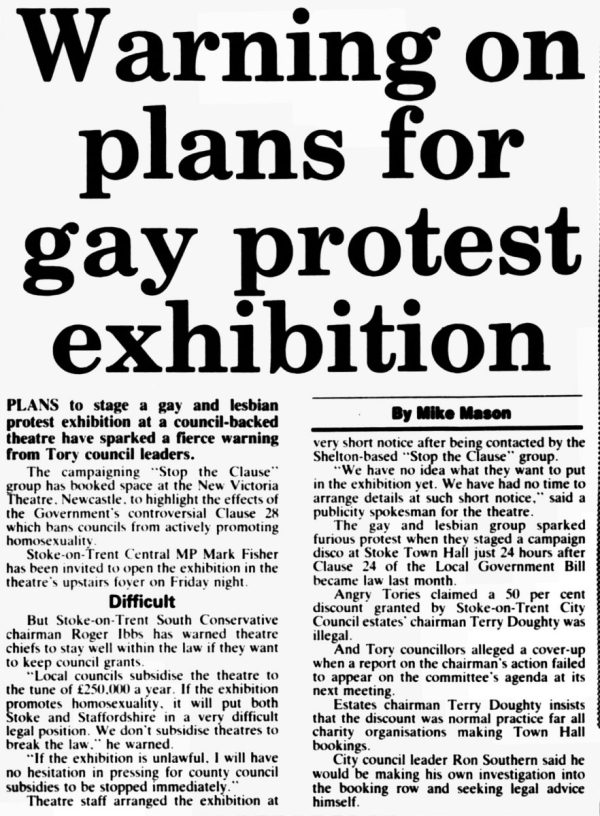
In June 1988, the “Stop the Clause” group organised a protest exhibition at the New Victoria Theatre in Newcastle-under-Lyme. The exhibition, which Stoke-on-Trent Central MP Mark Fisher was invited to open, sparked an immediate “fierce warning” from local Conservative leaders. Tory chairman Roger Ibbs cautioned that if the exhibition was found to “promote homosexuality,” it would place the council in a “very difficult legal position” and could lead to the immediate withdrawal of the theatre’s £250,000 annual subsidy.
In the same week it was reported that Staffordshire County Council had faced a challenge from the National Council for Civil Liberties after it formally barred gay men and lesbians from its equal opportunities advisory sub-committee. Senior councillors defended the move by claiming that LGBT+ individuals were not covered by equal opportunities legislation.
These controversies highlighted that concerns about the wide ranging effects of Clause 28 were justified
Evening Sentinel 15th Jun 1988
Evening Sentinel 17th June 1988
Stop the Clause Disco
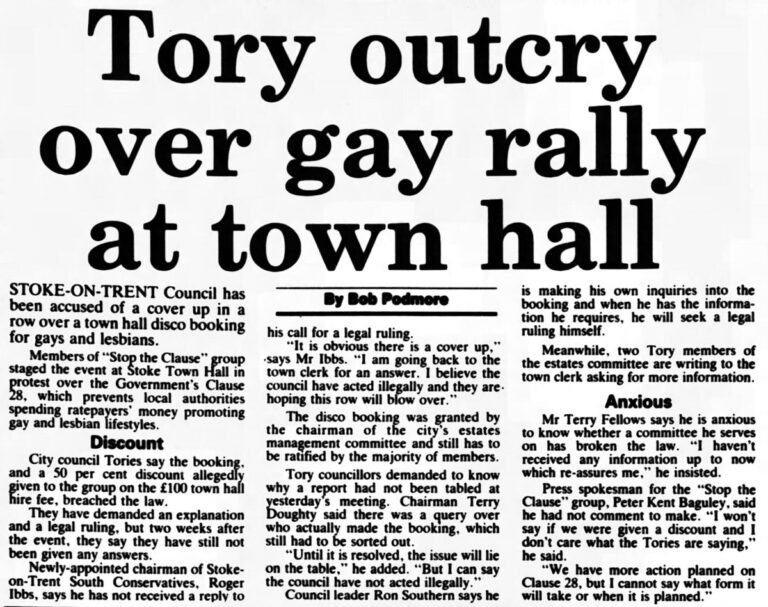
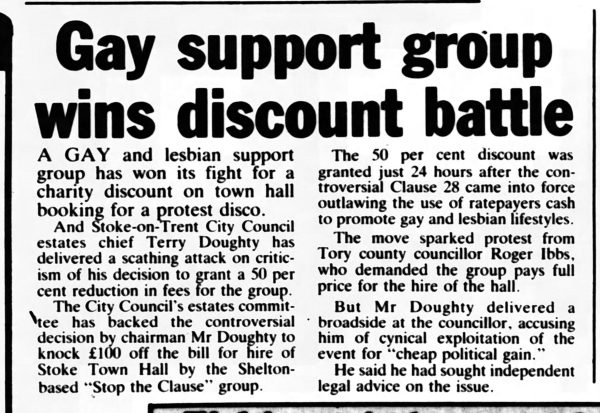
There was further controversy over “Stop the Clause” plans to hold a fundraiser disco at the Stoke-on-Trent Town Hall. The group had been offered a 50% discount when the booking was made. Despite conservative opposition the discount was upheld.
Evening Sentinel 8th Jun 1988
Evening Sentinel 12th Jul 1988
Clause 28 remained in force for fifteen years until it was finally repealed on 18 November 2003 in England and Wales (it had gone three years earlier in Scotland on 21 June 2000). Community mobilisation in the wake of Clause 28 had led to the formation of national campaigning charity Stonewall and a huge increase in activism. The response to censorship was to shout louder, and the battle for equality was actually strengthened by this oppressive legislation.
If you can help us expand on this history please share your comments below!
Please send your comments and suggestions using the form at the bottom of this page. If you’d like to share photos, media, or additional information, please Contact Us. To prevent spam and malicious content, all comments are reviewed before being published. Any information you share may be used in articles on or website or in our community newsletters and other publications.
Thank you for your help – our history is important, lets make sure it’s not hidden or forgotten!
We use cookies on our website to give you the most relevant experience by remembering your preferences and repeat visits. By clicking “Accept All”, you consent to the use of ALL the cookies. However, you may visit "Cookie Settings" to provide a controlled consent.
This website uses cookies to improve your experience while you navigate through the website. Out of these, the cookies that are categorized as necessary are stored on your browser as they are essential for the working of basic functionalities of the website. We also use third-party cookies that help us analyze and understand how you use this website. These cookies will be stored in your browser only with your consent. You also have the option to opt-out of these cookies. But opting out of some of these cookies may affect your browsing experience.
Necessary cookies are absolutely essential for the website to function properly. These cookies ensure basic functionalities and security features of the website, anonymously.
Cookie
Duration
Description
cookielawinfo-checkbox-analytics
11 months
This cookie is set by GDPR Cookie Consent plugin. The cookie is used to store the user consent for the cookies in the category "Analytics".
cookielawinfo-checkbox-functional
11 months
The cookie is set by GDPR cookie consent to record the user consent for the cookies in the category "Functional".
cookielawinfo-checkbox-necessary
11 months
This cookie is set by GDPR Cookie Consent plugin. The cookies is used to store the user consent for the cookies in the category "Necessary".
cookielawinfo-checkbox-others
11 months
This cookie is set by GDPR Cookie Consent plugin. The cookie is used to store the user consent for the cookies in the category "Other.
cookielawinfo-checkbox-performance
11 months
This cookie is set by GDPR Cookie Consent plugin. The cookie is used to store the user consent for the cookies in the category "Performance".
viewed_cookie_policy
11 months
The cookie is set by the GDPR Cookie Consent plugin and is used to store whether or not user has consented to the use of cookies. It does not store any personal data.
Functional cookies help to perform certain functionalities like sharing the content of the website on social media platforms, collect feedbacks, and other third-party features.
Performance cookies are used to understand and analyze the key performance indexes of the website which helps in delivering a better user experience for the visitors.
Analytical cookies are used to understand how visitors interact with the website. These cookies help provide information on metrics the number of visitors, bounce rate, traffic source, etc.
Advertisement cookies are used to provide visitors with relevant ads and marketing campaigns. These cookies track visitors across websites and collect information to provide customized ads.