Timeline of LGBT+ History for Stoke-on-Trent and Staffordshire
1999 – Admiral Duncan Nail Bomb Attack
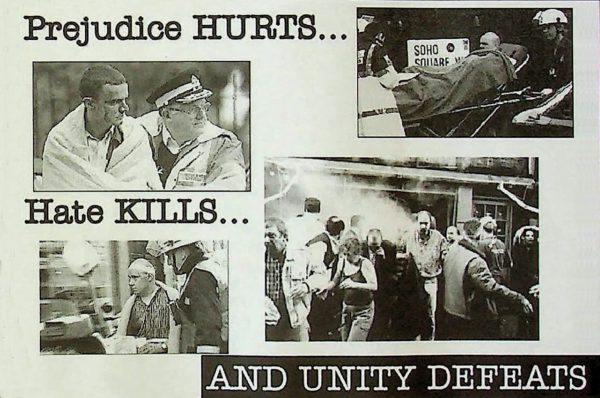
A flier created by ShropGay Health distributed in Stoke and Staffordshire
In April 1999, London was shaken by a series of three nail bomb attacks deliberately targeting minority communities. On 17 April a bomb exploded in Brixton, an area with a large Black community, followed a week later by one at the heart of London’s Bangladeshi community in Brick Lane. On 30 April a third bomb exploded inside the Admiral Duncan, a gay pub in Soho. Across these three attacks, three people were killed and more than 140 were injured. All three deaths occurred in the Admiral Duncan bombing, where Andrea Dykes, John Light and Nik Moore lost their lives.The local impact of these shocking attacks by a neo-Nazi are explored in this post.
Coverage in the Evening Sentinel
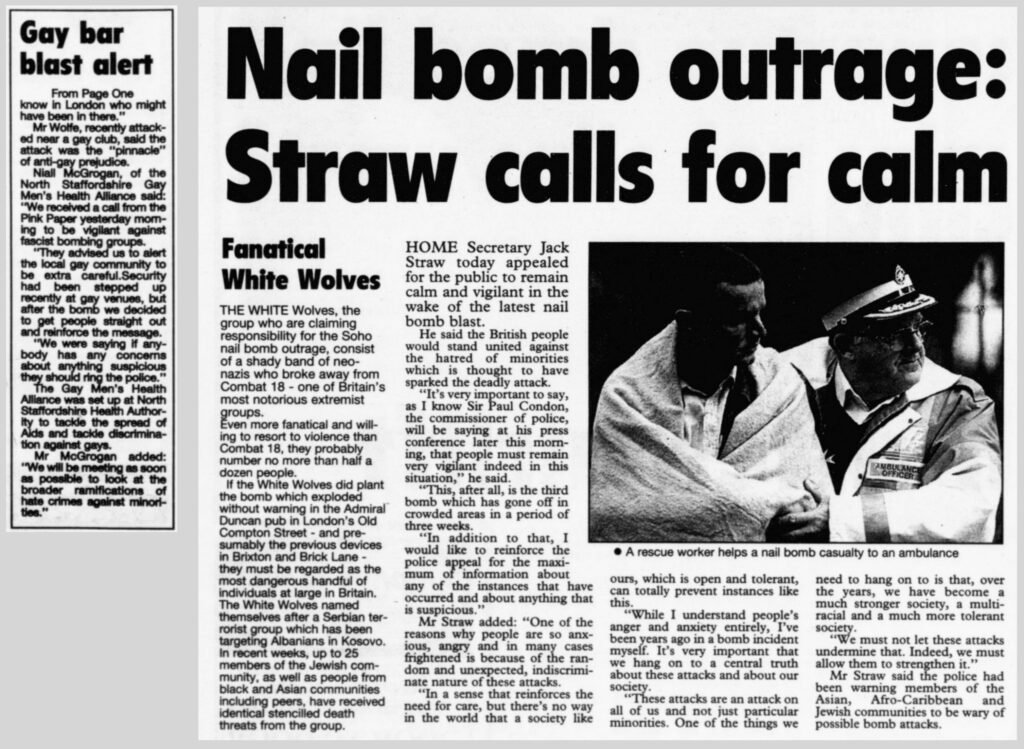
Reports tells us that the initial attacks had raised local concerns even before the third bomb exploded. Following the bombs in Brixton and Brick Lane, gay organisations had been warned that LGBT+ venues might be the next target. On the morning of 30 April, the Pink Paper contacted the North Staffordshire Gay Men’s Health Alliance (G-MHAP), warning them to be vigilant and asking them to alert the local gay community. Security had already been increased at local gay venues following a recent homophobic attack on Mike Wolfe, Chair of the North Staffordshire Lesbian and Gay Forum.
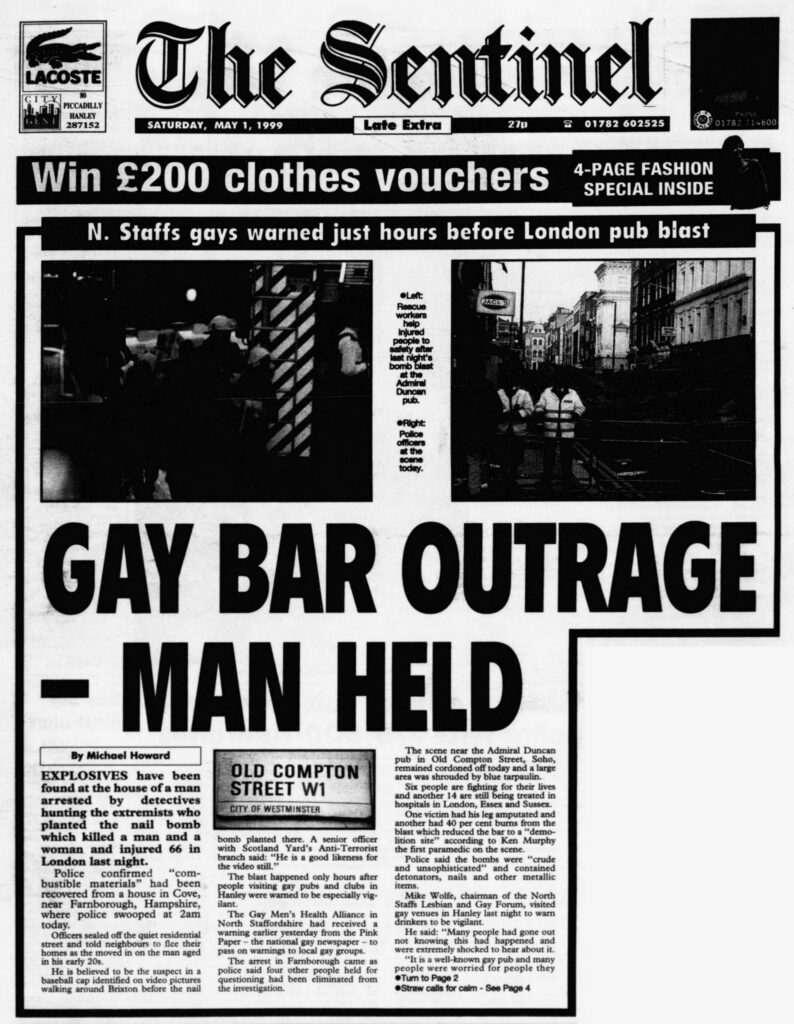
Just hours later, the third bomb exploded inside the Admiral Duncan. The following day’s Sentinel made the attack its front-page story under the headline “Gay Bar Outrage – Man Held” and reported that Mike Wolfe and other members of the Forum had visited gay venues in Hanley that evening to warn people to remain vigilant.
The warnings came at an already unsettling time for the local gay community. Mike Wolfe had himself been attacked outside a gay venue only three months earlier, an assault described locally as the “pinnacle” of anti-gay prejudice.
Clips from the Staffordshire Sentinel 1st May 1999, the day after the third bomb exploded.
Local LGBT+ Community Responses
The bombings were understood not simply as an attack on one London gay pub, but as attacks motivated by hatred of minority communities. That sense of shared outrage was also reflected in LGBT+ and HIV organisations in North Staffordshire and neighbouring areas.
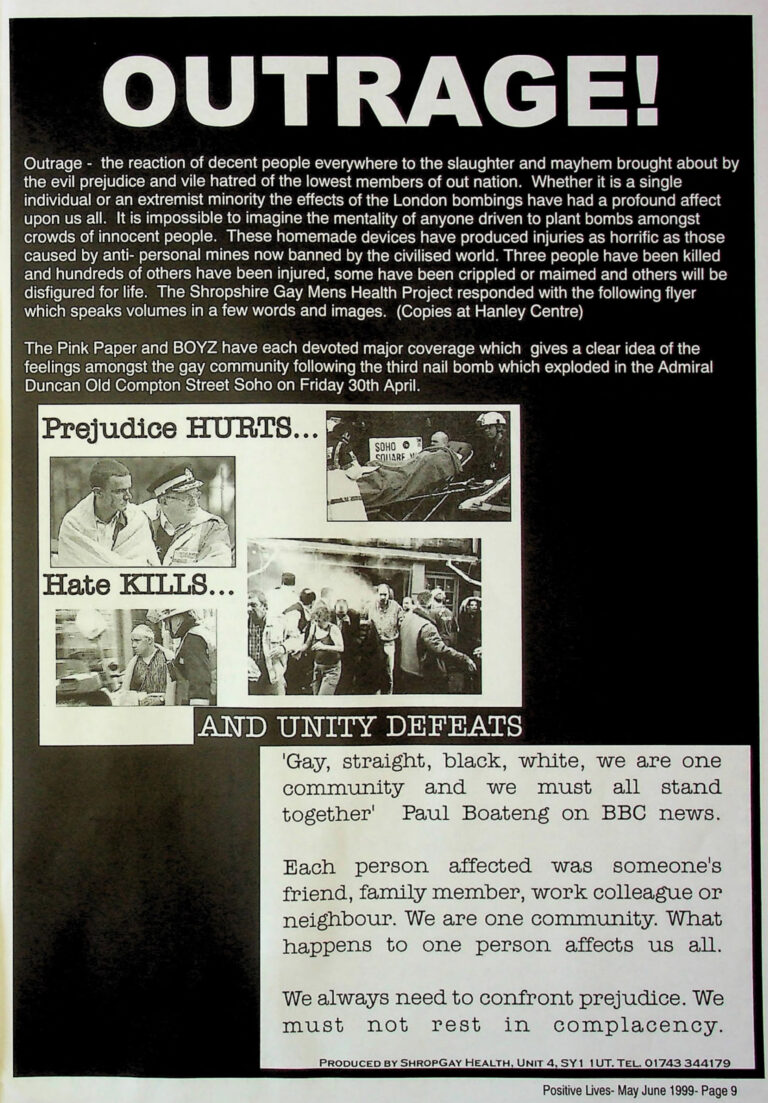
Local HIV charity Staffordshire Buddies published this in Positive Lives newsletter May-June 1999. ShropGay Health, publisher of the illustrated flier, was a gay men’s health project managed by Staffordshire Buddies.
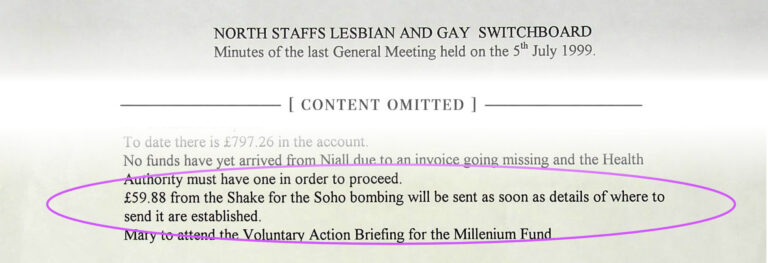
In the weeks and months that followed, further articles and comments appeared in local community publications Positive Lives and Pink Lobby. Minutes of the North Staffs Lesbian and Gay Switchboard record a local collection had been made in support of the victims of the Soho bombing.
Minutes of the North Staffs Lesbian and Gay Switchboard, 5 July 1999
Remembrance
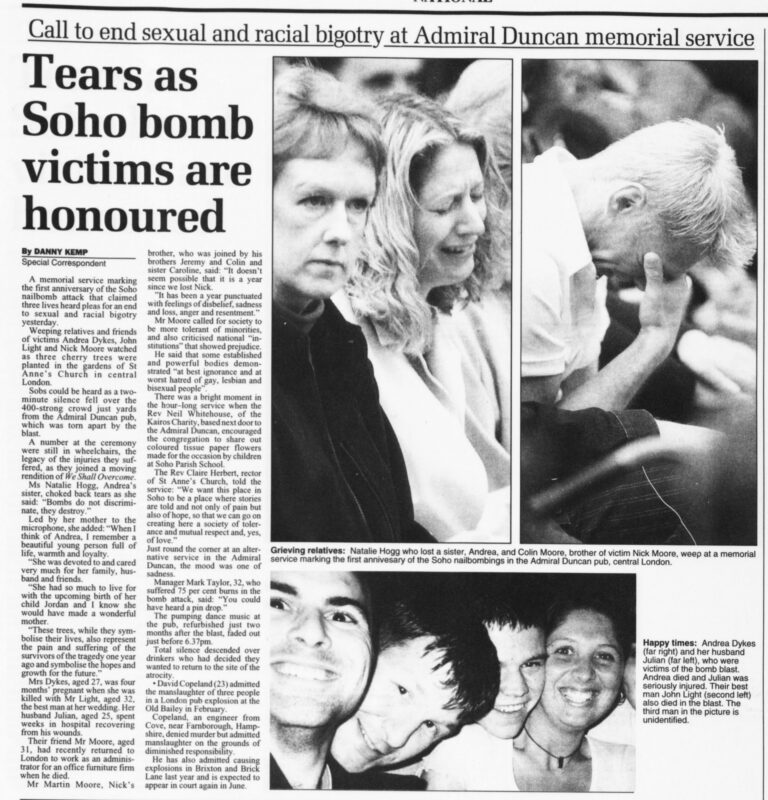
Birmingham Daily Post 1 May 2000
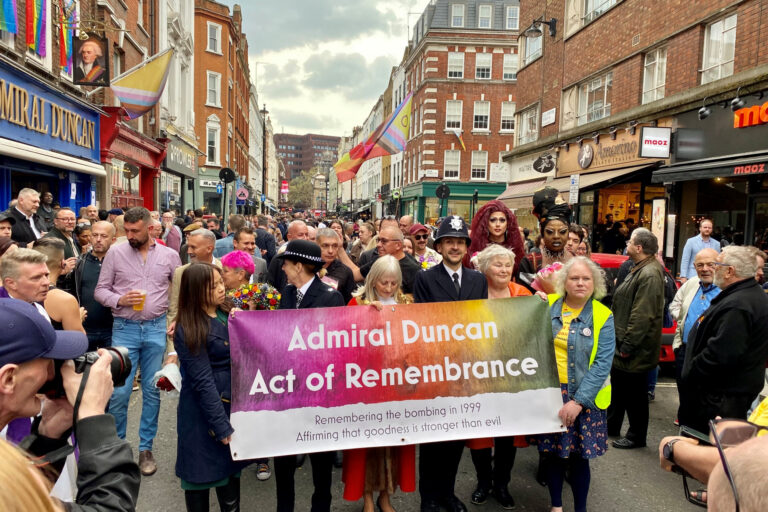
The victims of the Admiral Duncan bombing were annually remembered in the years that followed. On 30 April 2000, hundreds gathered at St Anne’s Church and in Soho, where three cherry trees were dedicated to Andrea Dykes, John Light and Nik Moore. A two-minute silence was observed at 6.37pm, the time of the explosion, while three candles burned inside the Admiral Duncan. Survivors, relatives and friends continued to gather in St Anne’s Gardens on subsequent anniversaries, and a memorial bench was later installed there.
In 2009, the tenth anniversary led to the creation of 17-24-30, named after the dates of the three attacks: Brixton on 17 April, Brick Lane on 24 April and Soho on 30 April. The organisation established annual April Acts of Remembrance for the communities targeted by the bombings. These continue today, including the gathering outside the Admiral Duncan each 30 April.
Later in 2009, following the death of gay man Ian Baynham after a homophobic attack in Trafalgar Square, 17-24-30 organised the first London Vigil Against Hate Crime. More than 10,000 people attended, and further vigils followed. In 2012 these developed into National Hate Crime Awareness Week, widening the focus from individual attacks to all communities affected by hate crime while retaining remembrance at its heart. At its first national service at St Paul’s Cathedral, the National Candle of Hope and Remembrance was lit in memory of Nik Moore, one of those killed at the Admiral Duncan.
If you can help us expand on this history please share your comments below!
Please send your comments and suggestions using the form at the bottom of this page. If you’d like to share photos, media, or additional information, please Contact Us. To prevent spam and malicious content, all comments are reviewed before being published. Any information you share may be used in articles on or website or in our community newsletters and other publications.
Thank you for your help – our history is important, lets make sure it’s not hidden or forgotten!
We use cookies on our website to give you the most relevant experience by remembering your preferences and repeat visits. By clicking “Accept All”, you consent to the use of ALL the cookies. However, you may visit "Cookie Settings" to provide a controlled consent.
This website uses cookies to improve your experience while you navigate through the website. Out of these, the cookies that are categorized as necessary are stored on your browser as they are essential for the working of basic functionalities of the website. We also use third-party cookies that help us analyze and understand how you use this website. These cookies will be stored in your browser only with your consent. You also have the option to opt-out of these cookies. But opting out of some of these cookies may affect your browsing experience.
Necessary cookies are absolutely essential for the website to function properly. These cookies ensure basic functionalities and security features of the website, anonymously.
Cookie
Duration
Description
cookielawinfo-checkbox-analytics
11 months
This cookie is set by GDPR Cookie Consent plugin. The cookie is used to store the user consent for the cookies in the category "Analytics".
cookielawinfo-checkbox-functional
11 months
The cookie is set by GDPR cookie consent to record the user consent for the cookies in the category "Functional".
cookielawinfo-checkbox-necessary
11 months
This cookie is set by GDPR Cookie Consent plugin. The cookies is used to store the user consent for the cookies in the category "Necessary".
cookielawinfo-checkbox-others
11 months
This cookie is set by GDPR Cookie Consent plugin. The cookie is used to store the user consent for the cookies in the category "Other.
cookielawinfo-checkbox-performance
11 months
This cookie is set by GDPR Cookie Consent plugin. The cookie is used to store the user consent for the cookies in the category "Performance".
viewed_cookie_policy
11 months
The cookie is set by the GDPR Cookie Consent plugin and is used to store whether or not user has consented to the use of cookies. It does not store any personal data.
Functional cookies help to perform certain functionalities like sharing the content of the website on social media platforms, collect feedbacks, and other third-party features.
Performance cookies are used to understand and analyze the key performance indexes of the website which helps in delivering a better user experience for the visitors.
Analytical cookies are used to understand how visitors interact with the website. These cookies help provide information on metrics the number of visitors, bounce rate, traffic source, etc.
Advertisement cookies are used to provide visitors with relevant ads and marketing campaigns. These cookies track visitors across websites and collect information to provide customized ads.