


Timeline of LGBT+ History for Stoke-on-Trent and Staffordshire
The Dancing Marquess of Beaudesert
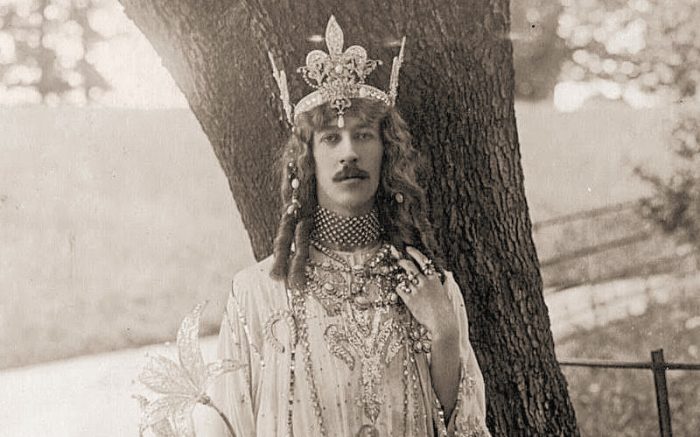
“The Dancing Marquess” Henry Cyril Paget, 5th Marquess of Anglesey and Principal landowner of the Beaudesert estate in Staffordshire from 1898 to 1905
When Henry Paget inherited the title of 5th Marquess of Anglesey in 1898, he became one of the wealthiest young men in Britain. He also became one of its most unapologetically unique. Today, he is celebrated as an LGBT+ icon for his radical gender-nonconforming theatricality. However, for the people of Staffordshire, his legacy was defined by a spectacular financial collapse that permanently altered the local landscape.
While the family’s grandest seat was Plas Newydd in Wales, their ancestral heartland was the Beaudesert estate on the edge of Cannock Chase in Staffordshire. The Paget family had deep roots in the county, commanding vast areas of land and wielding massive political and economic influence over generations of Staffordshire residents. Upon his father’s death, 23-year-old Henry inherited this sprawling estate, along with an income that would be worth millions today.
As Paget Family heir, Henry was also “Lord of the Manor” in Burton-on-Trent; the family’s estate business was still run out of the old Burton abbey manor offices and he was The President of the Burton Infirmary, The President of the Amateur Regatta and a trustee of the Burton Charities though he likely took little active part in the work of those organisations and rarely visited the town.
The Dancing Marquess
Henry had little interest in the traditional duties of a country squire. Instead, he transformed the family chapel at Anglesey into a 150-seat theatre and poured his fortune into costuming and performance.
Dubbed the “Dancing Marquess,” Henry toured Britain and Europe with his own professional theatre company. Long before modern concepts of gender fluidity were widely understood, Henry challenged rigid Victorian and Edwardian norms by:
Performing highly expressive, sinuous dances—most famously his “Butterfly Dance.”
Draping himself in floating silk robes, elaborate tiaras, and real jewels.
Actively blurring the lines between masculine elite status and feminine theatrical aesthetic, entirely unbothered by the societal expectations of a British peer.
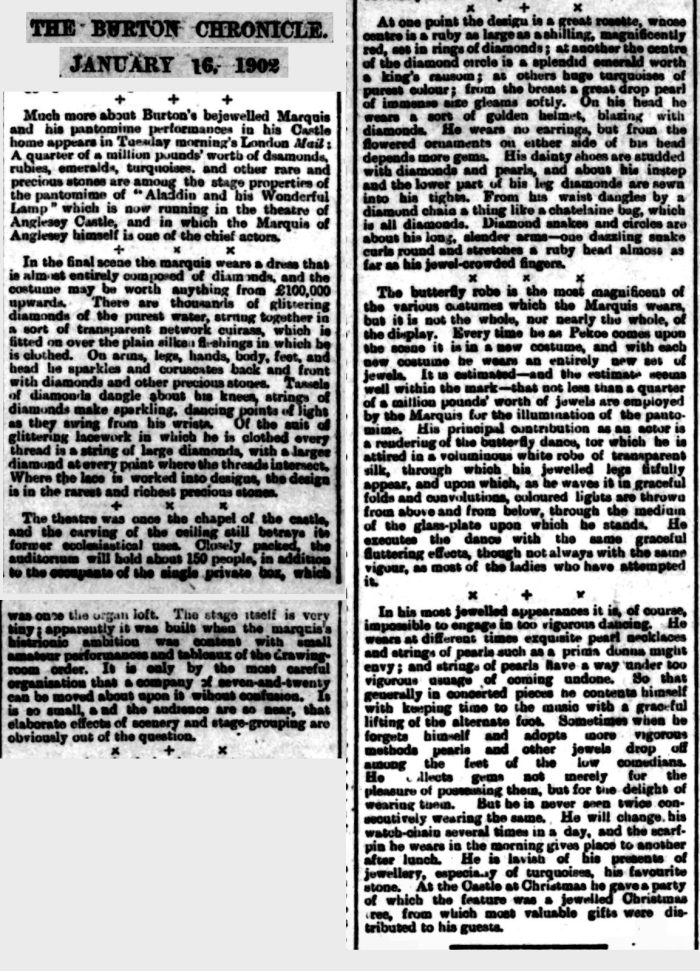
The Burton Chronicle, 16 Jan 1902
This article from the Burton Chronicle gives a local report of an extraordinary theatrical pantomime performance of Henry Paget. It introduces him as “Burton’s bejewelled Marquis” detailing Henry’s dazzling performance as Pekoe in the pantomime Aladdin and his Wonderful Lamp, which was staged inside the private theatre he had converted from an old chapel at his Anglesey castle home.
The piece describes the staggering scale of his wardrobe, noting that his various costumes utilized an estimated £250,000 worth of real diamonds, rubies, emeralds, and pearls. For the final scene, Henry wore a transparent network cuirass made entirely of strings of diamonds over plain silk tights. His attire also included diamond-studded shoes, diamond snakes wrapped around his arms, and a golden helmet. The paper described his main performance as a “butterfly dance” executed in a voluminous white silk robe over an illuminated glass floor, noting that he performed the dance with a graceful, fluttering effect.
The Marquess Performs in Lichfield
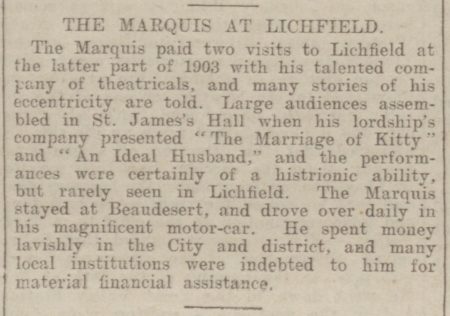
The Lichfield Chronicle, 17 Mar 1905
This snip is from a much longer article reporting “The Death of Lord Anglesey” which reviewed in great detail his life and his local connections. It tells us that he paid two visits to Lichfield in 1903 with his touring theatre company; the choice of plays is significant:
“An Ideal Husband” by Oscar Wilde: Oscar Wilde had died in disgrace only three years prior in 1900 after his imprisonment for “gross indecency.” Performing a Wilde play at this time was provocative, subversive, and an overt nod to the aesthetic and decadent movements. Academic sources tell us that Henry Paget didn’t just produce this play; he starred in it himself, taking on the role of Lord Goring—a witty dandy who is obsessed with fashion, buttons, and avoids traditional work, a character that Henry may have identified himself with. (See University of Kent). Goring is also a mouthpiece for Wilde’s beliefs about society pointing out the hypocrisy of high-society expectations and moral perfectionism.
“The Marriage of Kitty”: was a highly popular, sparkling West End comic farce adapted from a French play. It follows a man who enters into a temporary, unconsummated “marriage of convenience” to secure a fortune, only to fall in love later. Given Henry’s own headline-making annulment based on non-consummation just a couple of years earlier, performing this play was an incredibly cheeky, self-aware wink to the public about his own marital scandals.
The clipping notes large audiences assembled at St. James’s Hall. This was Lichfield’s premier entertainment hub of the era, located on Bore Street (the site later became a cinema and is now a block of flats near the Guildhall). Henry choosing to perform in a popular public theatre shows his genuine desire to be seen and celebrated by ordinary local people.
The article speaks of his popularity and generosity; despite Henry’s eccentricity or perhaps even because of it, he was loved and appreciated by people from the lower classes that he entertained and supported.
The Great Bankruptcy of 1904
Henry’s lifestyle was unsustainably lavish. He reportedly owned hundreds of pairs of silk pyjamas, custom fur coats, and even had his cars modified to spray perfume from the exhaust pipes. His theatrical costumes were studded with real precious jewels, a single outfit was likely worth more than a million pounds at today’s prices.
By 1904, just six years after inheriting his fortune, Henry had racked up a staggering debt of around £544,000 (roughly £70 million today). Henry’s creditors tried to handle his catastrophic debt through a private ‘Deed of Assignment’, placing his income into the hands of trustees. However, his spending was too vast to control. By June of that year, the private arrangement failed and Henry was officially declared bankrupt.
To pay off the creditors, the courts ordered a massive, unprecedented clearing out of the family estates. In late 1904 and early 1905, huge auctions were held to sell the contents of Henry’s Anglesey home and his ancestral seat at Beaudesert.
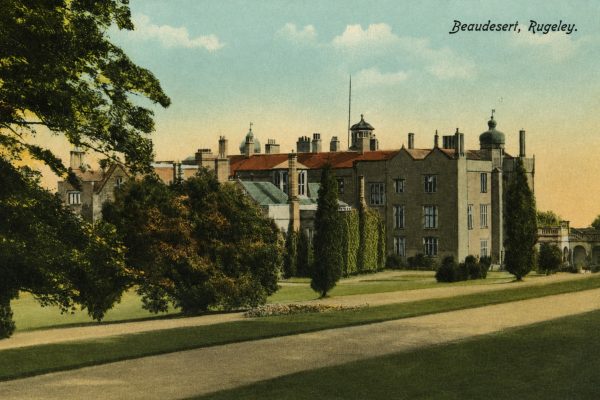
The Grand House of Beaudesert on Cannock Chase, Beaudesert roughly translates as Beautiful Wilderness.
The sales included Henry’s vast collection of jewellery and bejewelled items, his fleet of custom motor cars, a hundred fur coats and more than three hundred walking canes many heavily encrusted with real diamonds, rubies, and emeralds. Newspaper reports informed a fascinated public that the auctioneers spent three full days just selling off his undergarments including a “mountain of toilet underwear” and hundreds of pairs of silk pyjamas in every imaginable colour.
The sale of items from Beaudesert included furniture, paintings, a Chippendale cased organ and one of the finest libraries in the country. Paget family members bought back some items in attempts to salvage their ancestry such as mahogany hall-chairs painted with the Anglesey arms, family miniature portraits and a bust of the third Marquess. It is hard to comprehend the scale and devastation of their losses just a small portion of which are mentioned in the following article.
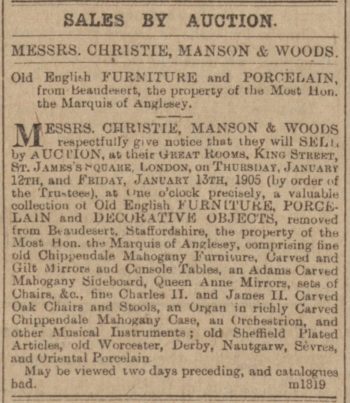
The Lichfield Mercury 30th December 1904
A Tragic Ending
Having sold the contents of both his great houses to pay his debts Henry fled to Monte Carlo to begin a new chapter in his life. This was tragically short as he died of Tuberculosis on March 14, 1905 at the young age of just 29.
The laws of entailment meant that the great houses of Henry’s estate could not be sold to pay his debts and they passed to his cousin, Charles Paget, who became the 6th Marquess of Anglesey as the next in the family line.
An article from the end of 1905 records a family party at their Anglesey home, it is perhaps unsurprising that they found cause to celebrate a new chapter in the family’s history.
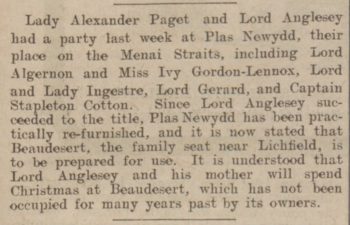
The Lichfield Mercury, Friday 1 Dec 1905
Following Henry’s death, the 6th Marquess began a massive project to restore the interior of Beaudesert to its original Elizabethan glory, a process accelerated after a significant fire damaged 15 rooms in November 1909. The family lived in the freshly remodeled mansion until 1920, when the crippling costs of upkeep and post-war taxation finally forced them to abandon it. Uninhabited and facing a bleak financial climate, the house was sold to demolition contractors and dismantled in 1935.
Was Henry Paget Homosexual?
The short answer is that we simply do not know. All of the personal papers, letters, and journals that might have illuminated Henry’s private and emotional life were systematically destroyed by his family after his death.
What we can say with certainty is that his penchant for flamboyant and feminine styles of dress provides undeniable evidence of a gender non-conformity that radically defied the social conventions of his time. He loved perfume, wore heavy makeup, and was a prominent example of what was then euphemistically referred to as the “theatrical type.” In our modern era, he has transcended the labels of his own time to be widely celebrated as a “Queer” icon of the Victorian and Edwardian eras.
With regard to relationships with women, Henry Cyril Paget married his first cousin, Lilian Florence Maud Chetwynd, on January 20, 1898 but the marriage did not last. While a decree nisi for divorce was initially granted in 1900 on the grounds of non-consummation, Lily curiously returned to court in 1902 to have that decree nullified in favour of an official judicial separation. This would have provided substantial financial protections for her, while simultaneously ensuring there would be no societal pressure for Henry to marry again. Despite the legal dissolution of their relationship, a deep bond clearly endured; Lily travelled to France years later and was faithfully by Henry’s bedside in Monte Carlo when he died.
The Next Generation of Gender Non-Conformity
Lady Caroline Paget
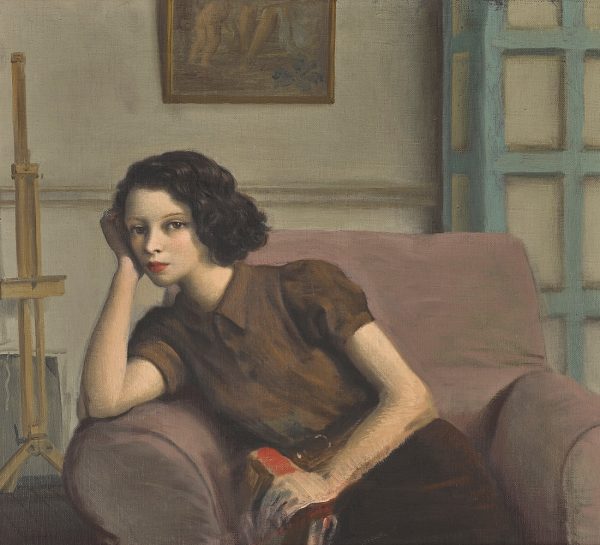
A Portrait of Lady Caroline Paget by Rex Whistler
Henry Paget’s defiance of Edwardian norms was not the end of the family’s link to LGBT+ history. When Henry’s cousin, Charles Paget, inherited the title as the 6th Marquess in 1905, the Beaudesert estate became the family’s primary residence. It was here that his daughter, Lady Caroline Paget (1913–1973), was born on June 15, 1913, just as her father was completing a massive, multi-year architectural restoration to repair the damage of Henry’s era.
The family lived at Beaudesert through the 1910s and the First World War. Caroline spent her formative early childhood roaming the grand Staffordshire estate, but she was only seven years old when the family finally packed up, abandoned the house, and moved permanently to their Welsh estate, Plas Newydd, in 1920 due to the crippling financial aftermath of Henry’s lingering debts and rising post-war taxes.
As she grew up, Caroline carried the family’s signature spirit of radical, artistic non-conformity into a new era. Becoming a prominent bisexual socialite and actress in the 1930s, she openly defied the rigid conventions of her aristocratic upbringing. She ultimately left her traditional social circle to set up house in Chelsea with her partner, the lesbian playwright Audrey Carten, living in a relationship that defied the expectations of her era as much as Henry’s life had done a generation before.


Copyright Notice
News clippings in this post were compiled by Andrew Colclough from various archives as part of his personal research into local LGBT+ history and are shared here for educational purposes on the basis of fair personal/non commercial use. Copyright, where applicable, remains with the original publishers. Photographs are believed to be in the public domain and sources are credited where possible – please contact us if any further permissions or acknowledgments are required. All original text is © Andrew Colclough. Thank you!