

Timeline of LGBT+ History for Stoke-on-Trent and Staffordshire
1976 – The Gay Group at Keele
We would love to hear from anyone who can help us add to this post. Please share your memories using use the form at the bottom of this page or contact us.
The history of gay groups at Keele University is a story of transition from discrete early inquiries to radical activism, eventually evolving into an institutionalised part of student life. The first recognisable advertised gay group in North Staffordshire was the Gay Liberation Front group established by students at Keele University in the early 1970s. This post explores these early foundations and the Gay Group that followed in 1976.
The Early 1970s: Gay Liberation and the “Police Purge”
The seeds of a gay movement at Keele were planted as early as May 1971, when a notice in the Head Porter’s papers says “We are hoping to talk with as many homosexuals at Keele as possible to get some idea of the situation here,” while promising that “there will be no risk of disclosure”. By late 1971, student motions began calling for the “representation of various groups on Rag Procession floats including gay liberation”.
The Keele Gay Lib Soc (Gay Liberation Society) established itself early in 1972. An advertisement for a Keele Gay Liberation Front meeting appeared in the Evening Sentinel newspaper in March and other publicity followed. However, this visibility drew unwanted attention and the society was targeted by the Staffordshire Police who reportedly monitored the group’s meetings while compiling a “dossier on all known gays in the Potteries”.
A publicity circular dated 27th October invited students to “Gay Liberation: Come together brothers and sisters” at the Horwood General Block, indicating the group was still meeting undeterred by the police action.
Despite persecution, student support grew. In April 1973, the Keele Students’ Union passed a landmark motion that “abhorred discrimination on the grounds of sexual preference” and pledged support for any student or staff member facing such treatment.
By around 1974–75, the Gay Liberation Front (GLF) had ceased operating as a unified national movement and the Keele Gay Lib group appears to have dissolved. Read more about the history of the The Gay Liberation Front…
1976 – The Gay Group
The article below tells us that a Gay Group was re-established in 1976. The reference to “re-formed” confirms that there had indeed been a break and while the objectives include “gay liberation” this is no longer part of the name that the group calls itself.
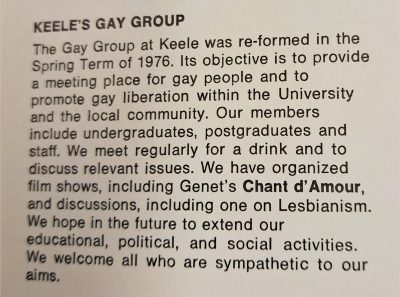
Entry in the Keele University Students Union Handbook 1976-77, transcription below
KEELE’S GAY GROUP
The Gay Group at Keele was re-formed in the Spring Term of 1976. Its objective is to provide a meeting place for gay people and to promote gay liberation within the University and the local community. Our members include undergraduates, postgraduates and staff. We meet regularly for a drink and to discuss relevant issues. We have organized film shows, including Genet’s Chant d’Amour, and discussions, including one on Lesbianism. We hope in the future to extend our educational, political, and social activities. We welcome all who are sympathetic to our aims.
1976 would have been the year that Mike Jackson became a student. In 1977 Mike was part of the group of students involved in setting up the North Staffs Gay Switchboard and he was later known as the co-founder of Lesbians and Gays support the miners.
By the 1977-78 academic year, the Gay Group had dropped references to gay liberation and expanded its aims to:
stimulate debate and to educate people on matters relating to Gay Politics.
encourage homosexual or bisexual students and staff to ‘come out’.
provide social contacts for gay and bisexual women and men on campus in what might otherwise be a hostile or isolating atmosphere.
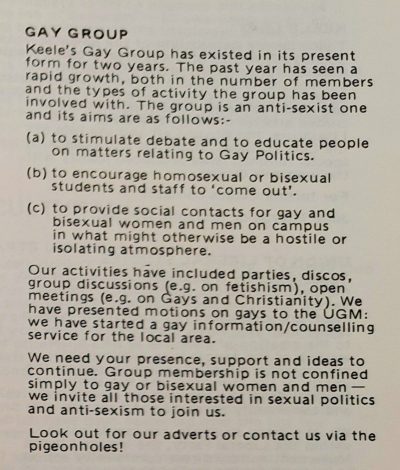
Entry in the Keele University Students Union Handbook 1977-78, transcription below
GAY GROUP
Keele’s Gay Group has existed in its present form for two years. The past year has seen a rapid growth, both in the number of members and the types of activity the group has been involved with. The group is an anti-sexist one and its aims are as follows:-
(a) to stimulate debate and to educate people on matters relating to Gay Politics.
(b) to encourage homosexual or bisexual students and staff to ‘come out’.
(c) to provide social contacts for gay and bisexual women and men on campus in what might otherwise be a hostile or isolating atmosphere.
Our activities have included parties, discos, group discussions (e.g. on fetishism), open meetings (e.g. on Gays and Christianity). We have presented motions on gays to the UGM: we have started a gay information/counselling service for the local area.
We need your presence, support and ideas to continue. Group membership is not confined simply to gay or bisexual women and men — we invite all those interested in sexual politics and anti-sexism to join us.
Look out for our adverts or contact us via the pigeonholes!
1981 – N.U.S. Gay Lib. Week of Action
In 1981 an article titled “N.U.S. Gay Lib. Week of Action,”published in “Concourse” provides us with an insight into the challenges presented by a gay population that preferred to remain hidden.
The article tells us that the primary obstacle facing the Gay Society was a profound lack of visible members. Out of a student body of nearly 3,000, only about a dozen had “come out,” and only two out of approximately 300 lecturers were openly gay. This disparity between the estimated gay population and those willing to express their sexuality created an atmosphere of “hopelessness” which underpins the need for a “Week of Action” to stir consciences and encourage others to come out.
Organised in collaboration with the university’s anti-sexist group, the week featured a variety of events designed to raise the group’s profile. While the week faced initial setbacks – including equipment failures for a film screening and a sparsely attended party that left members feeling isolated – it did eventually gain momentum.
Key highlights included:
- Educational Talks: A history talk on “Women in the Pottery Industry” and a lecture by Ursula Sharma from the Sociology Department.
- Cultural Visibility: A successful concert featuring the bands ‘Innuendo’ and ‘The Man Upstairs’ which drew a crowd of 150 people.
- Community Support: All profits from the concert were donated to the Gay Switchboard in Hanley.
- Literary Presence: A selection of books was displayed in the Union Concourse to further assert the society’s existence to the “apathetic world”.
A Call to Action
In response to the low turnout at social events, several members took the brave step of publicising their own names as points of contact for anyone needing support. The article concludes with an urgent plea for the gay community at Keele to become more than just “a dozen anonymous people” and reminds readers of the broader national context of “aggressive harassment” and police persecution of gay individuals. Students were urged to sign petitions against this “disgusting persecution”, linking the local struggle for visibility at Keele to the wider fight for civil rights.
Mid 1980s – Activism, Apathy, and the AIDS Crisis
In June 1984 a publicity circular advertised a disco at the 141 club in Hanley taking place on Wed 4 July with free tickets available in advance for GaySoc members or pay £1 on the door. The publicity states that non members can only gain admission with a Gaysoc member or ticket holder, likely a part of attempts to boost membership of the group.
Suggestions of wider political radicalism appear in the November 1984 publicity circular advertising a joint meeting with the Anarchist-Communist Group titled “Towards a Gay Communism,” though it was later cancelled due to “reactionary capitalist intrigue”. Also of interest in this publicity circular (below) is a passing mention of raising funds for Lesbians and Gays Support the Miners.
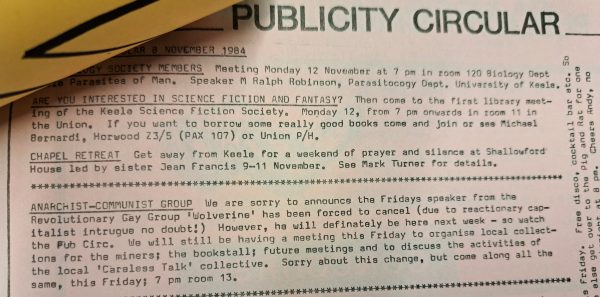
Publicity circular Nov 1984
Frustration with both internal apathy and external hostility emerges again in a 1985 circular that sharply criticised members: “Gay? Sick of Gaysoc doing nothing? It’s your own bloody fault!!!”. This same period saw the group reacting to the “A.I.D.S. ‘epidemic’,” with activists warning that gay men were being “media bashed” and urging students to “Act now — or there’ll be NO GAYSOC next year”.
Later in 1985 a more light-hearted entry in October extends an invitation to an “evening of social intercourse”. A pun that reminds us that for gay students under 21 social intercourse is the only kind of intercourse that was legal at that time.
Late 1980s – Isolation and Alienation
Section 28 of the Local Government Act came into force in May 1988, prohibiting local authorities from intentionally promoting homosexuality or promoting the acceptability of homosexuality. This added to the growing media hysteria over HIV and AIDS which had been characterised as a “gay plague”.
In the year leading up to Section 28 being passed into law the provisions had been hotly debated. The public mood and media conversation surrounding LGBT+ people in 1987 was overwhelmingly hostile, marked by a moral panic that framed gay rights as a threat to children and part of a “loony left” political agenda
It is then hardly surprising to find that a December 1987 concourse article titled “Proud to be Gay? reports that gay students were struggling with issues of isolation and alienation. The question mark in the title of the article is significant, most gay students on campus were not “out” and many feared being identified. A member quoted in the article stressed the importance of not constantly postponing ‘coming out’ as “it is an inevitably futile and often negative gesture: continually striving to be someone you are not is a soul destroying pretence”.
At this time the Gaysoc was using the Womens Resource Centre as a meeting place and, although they had no particular need for an office of their own, they felt that using the Womens Resource Centre presented problems. The simple act of visiting the society’s meeting place in the Students’ Union was daunting because potential members were “intimidated having to walk through the busiest part of the union,” where “questions are inevitably asked” when men were seen entering the womens space.
By 1987, membership had grown slightly to 19 people. The group reaffirmed their role as encouraging gay people to accept their sexuality and inspiring them to assert themselves in a predominantly heterosexual culture. They began planning a “Nightline” to provide a “friendly place and a willing ear for anyone wanting to discuss a particular problem”. (The North Staffs Gay Switchboard originally established at Keele had moved off campus into the Hanley City Centre in 1980)
A 1989 account detailed the “blatant discrimination” felt when trying to show “any normal affection whatsoever” in public, noting that while straight couples could kiss freely at bus shelters, gay students feared being “prosecuted” for “public indecency”. (Keep in Touch, Spring 1989).
By the end of the decade, gay community members were living with the depressing reversal of progress created by the draconian measures of Clause 28 and a relentless public backlash fuelled by the hysteria surrounding AIDS. The reaction to this was that activism increased and new national movements emerged to take the fight for equality forward.
1990s – Institutional Recognition
During the 1990s, LGB activism increased significantly, shifting towards more visible, confrontational, and rights-based campaigns in response to continued discrimination and the ongoing HIV/AIDS crisis. The following quotes from 1996 display a more forthright and confident voice:
If you’re actually born to be gay it’s one of the most natural things coming to you, isn’t it? [Homosexuality is unnatural] is said by people without homosexuality in their nature, who therefore deem their nature to be universal, which stretches arrogance beyond belief. These people forget to put the words “to me” at the end of the sentence. Heterosexuality is unnatural to me, except I have the thoughtfulness to accept difference.
The age of consent law is the biggest load of bollocks in the country. An 18-year-old can be imprisoned for sleeping with his 17-year-old boyfriend……shocking
Once I was walking along and passed two women whose arms were linked. A car went past and someone inside shouted “That’s against the law, you dykes”. One of them shouted back, “Well it’s not a very good law then, is it?”. Exactly. That is all we want changed.
From an article in Concourse, Dec 1996
In the 1990s, the group was renamed with the more explicitly inclusive title of the Keele Lesbian, Gay and Bisexual (LGB) Society. The society became a formal part of the Union’s structure, with the appointment of a “Lesbian, Gay and Bisexual (LGB) Officer” to the Union Committee.
The 1997 Freshers Handbook captured the emotional weight of joining the society: “Scared stiff? I know the feeling. We all do. Coming out can be hard. Even just admitting it to yourself can be a bit of a nightmare”. The group provided “confidential lunch-time meetings every Wednesday” and social trips to the scene in Manchester and Birmingham. By the end of the decade, the LGB society was officially listed as an “Associated Organisation” within the Students’ Union, alongside groups like Nightline and the student newspaper.
Over a period of three decades the group had evolved from a radical grassroots movement into an inclusive, institutionalised student society. This is signalled by the changes in the way the group presented itself in Gay News (later Gay Times) listings. In 1972, the group was known as the “Keele Gay Lib Society,” aligning with the first radical activist movement of the era. When the national Gay Liberation Front ended the group became known more simply as The Gay Group and by 1978 this had become “Gaysoc”, a title used for Gay Societies in universities throughout the UK. By 1995, the listing changed to “KEELE UNI LGB,” reflecting a formal move to include lesbian and bisexual identities in the society’s title.
Descriptions became more detailed and specific over time, moving from simply offering a contact point to advertsing actual meeting times and venues. This subtly but importantly signals increased visibility and confidence. Advances in communication technology likely helped the group transition from what was once a “life of secrecy” into a more accessible modern presence. A landmark change occurred in 1996 with the introduction of the society’s first email address, marking a shift toward the open and connected student organisation seen at the end of the century.
Nationally, the 1990s was a decade of increased activism resulting in the lowering of the age of consent for sex between men to 18 in 1994. A commons vote to equalise the age of consent at 16 was passed in 1998 only to be overturned a month later by the House of Lords. Highly organised and vocal campaigns pushing towards full equality in every aspect of social life continued and Section 28 was finally repealed in 2003. Most of the rights that the gay liberation movement set out to achieve have now been won. However, coming out is still difficult for many as the attitudes of those around us are not always accepting of transgressive sexual behaviours and gender identities. For students entering University an LGBTQ+ Society may still be the first step to coming to terms with an identity that may previously have been concealed.
2026 – The Keele LGBTQ+ Society
In 2026 the Keele LGBTQ+ society proudly declares that it has existed at Keele for over 50 years and aims to be a safe space for any LGBTQ+ identifying individuals or allies to the community.
The need for a safe space remains as this quotation from the current website demonstrates:
We also sometimes split our socials into closed and open doors. Meaning that socials can be closed off to non-members to ensure that members of the community who may not be out publicly also have a safe space they can attend. The location, dates and times of these are sent in society emails and on the discord only, for the protection of our members.
(Retrieved from the Keele LGBTQ+ society website, May 2026)
In our modern world the existence of a society for LGBTQ+ students at Keele University is uncontroversial and taken for granted. Perhaps this short history will help remind us of the long journey taken by successive generations and give cause to reflect on the reasons that a group may still be needed as much today as it was fifty years ago.
I am deeply grateful to Nicola Shipley of GRAIN photography for her two research trips to the Keele University Archives. Her diligent work was essential in surfacing the materials used to reconstruct this partial history of the Keele Gay Group. The article extracts featured here were photographed during those visits; the original materials remain the property of the Keele Archives and may be subject to third-party copyright. They are reproduced here in a limited capacity for non-profit, educational purposes.


Copyright Notice
News clippings in this post were compiled by Andrew Colclough from various archives as part of his personal research into local LGBT+ history and are shared here for educational purposes on the basis of fair personal/non commercial use. Copyright, where applicable, remains with the original publishers. Photographs are believed to be in the public domain and sources are credited where possible – please contact us if any further permissions or acknowledgments are required. All original text is © Andrew Colclough. Thank you!
Read and Submit Comments
If you can help us expand on this history please share your comments below!
Please send your comments and suggestions using the form at the bottom of this page. If you’d like to share photos, media, or additional information, please Contact Us. To prevent spam and malicious content, all comments are reviewed before being published. Any information you share may be used in articles on or website or in our community newsletters and other publications.
Thank you for your help – our history is important, lets make sure it’s not hidden or forgotten!
I learned something new from this post.