


Timeline of LGBT+ History for Stoke-on-Trent and Staffordshire
1972 – The Campaign for Homosexual Equality (CHE) in Stoke-on-Trent
We would love to hear from anyone who can help us add to this post. Please share your memories using use the form at the bottom of this page or contact us.

National CHE Badge
The Campaign for Homosexual Equality (CHE) in Stoke-on-Trent was part of a national network of CHE groups that formed across the UK in the period following the partial decriminalisation of sex between men. Our local group started in 1972 and initially met in members homes; then, as the gay scene developed, meetings moved into local clubs and pubs. Despite facing a hostile local press and intense police surveillance, the group maintained a presence in the city for over a decade until the Potteries Gay Community Association (PGCA) rose to prominence in the early 1980s.
How National Roots Became Local Branches
The Path to Reform: Wolfenden and the HLRS
The foundation for modern gay rights in Britain was laid in 1954 when the government established the Departmental Committee on Homosexual Offences and Prostitution, chaired by Sir John Wolfenden. The resulting Wolfenden Report (1957) recommended that consensual sexual acts between men in private should no longer be criminal, a highly controversial proposal at that time. In response to this report, the Homosexual Law Reform Society (HLRS) was founded in May 1958 to lobby for these recommendations to become law. It was ten years before the core recommendations made by Wolfenden passed into law when the Sexual Offences Act 1967 partially decriminalised sex between men over the age of 21 in private. The HLRS was primarily a national body, but it did attempt to seed local groups in cities like Stoke-on-Trent as early as the mid-1960s.
An Early Local Connection
Peter Scott-Presland’s impressive history of the CHE contains an intriguing reference to a very early local connection to the HLRS:
It was always the HLRS’s intention to set up more local groups, and there was a prospect of one in Stoke-on-Trent, but the convenor, a Methodist minister, cried off.
(Peter Scott Presland – Amiable Warriors Volume 1 page 140)
This was almost certainly Keith Groom, a well known local gay activist who became a convenor for our local CHE much later (see below). Keith’s obituary notice refers to his Methodist upbringing and that he was a lay preacher on the Kidsgrove circuit for many years. The period being discussed in the book is the mid 1960s but no specific date is attached to the event described in this excerpt. The reference to Keith having “cried off” does not reflect what we all remember about Keith’s brash and bold personality. It’s more likely that he decided to direct his efforts elsewhere.

Portrait of Keith Groom by Linda Cairnes
The Rise of Local Groups
Parallel to the lobbying efforts of the HLRS, a more grassroots movement began to take shape. On 7 October 1964, the North Western Homosexual Law Reform Committee (NWHLRC) was formed in Manchester. Following the 1967 Act, the organisation expanded its remit beyond mere legal reform and evolved into the Campaign for Homosexual Equality (CHE). While the 1967 Act provided a degree of legal protection, it did not signal social approval; consequently, the CHE focused on providing safe spaces where gay men and women could meet without the threat of “conspiracy” charges or police surveillance.
A key early ambition of the CHE was the creation of “Esquire Clubs“—safe, public social spaces modelled after traditional working men’s clubs. However, this vision faced immense obstacles, including a lack of funding and significant legal and police hostility toward the idea of public gay venues. As the dream of a national chain of clubs faded, the CHE pivoted its strategy toward establishing a widespread network of local CHE groups. These regional groups became the primary way that the CHE was able to expand its national reach.
CHE Groups in Staffordshire
A West Midlands CHE was established in March 1970 and divided itself into Birmingham CHE and Wolverhampton CHE within a year. Wolverhampton was historically part of the county of Staffordshire until 1974 – so Wolverhampton CHE was actually the first local CHE group to be established in Staffordshire.
The minutes attached to the CHE Monthly Bulletin Questionnaire for the Black Country Group dated 17 Apr 1973 record the group being renamed the Black Country Group having previously been the Wolverhampton Workers Group (HCA/CHE/7/141)
The Stoke-on-Trent group evolved from these early beginnings when a member associated with the Wolverhampton group set out to establish a group in Stoke in 1972 (see below).
There was also a CHE group in Burton-on-Trent mentioned in Gay News in 1978. However, the listing only appears a few times and it seems likely that the group did not successfully establish itself.
The Stoke-on-Trent CHE Group
The Stoke-on-Trent CHE Group
The Stoke-on-Trent CHE group began in March 1972 when Jerzy Zarach, a former member of the Wolverhampton group, wrote to the national CHE office offering to act as a convenor. It seems likely that Jerzy was a lecturer at Stoke Polytechnic as the distinctive name is associated with a few publications that reference this. We don’t know much about him except that he lived near Market Drayton. He may or may not have been gay as many early activists were allies of the campaign for equality and were not necessarily homosexual themselves. In any event what we can say with certainty is that he was brave enough and persistent enough to get a group going despite considerable challenges.
The national office provided Jerzy with an “inaugural list” of six local members in April 1972 to facilitate the group’s formation and by August 1972, the group had grown to 14 members living within a 15-mile radius of Stoke and it was officially recognised by the CHE Executive Committee.
However, the group encountered significant obstacles that hindered its early growth including the difficulties of placing advertisements in a hostile local press and a campaign of police surveillance that made attempts to attract members more difficult. Many gay people were fearful of being identified because homosexuality was still publicly stigmatised and disapproved of.
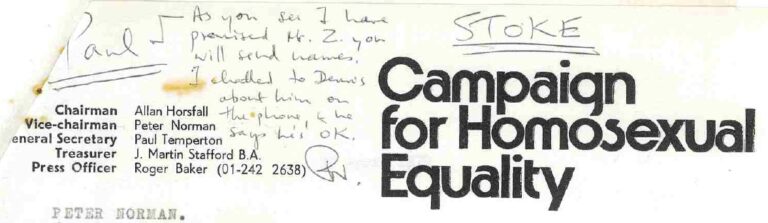
This heading is from the copy of a letter sent 27 March 1972 by Peter Norman (Vice Chairman of the national CHE) to Jerzy Zarach promising to send names of potential members to get a Stoke group started. The handwritten note states that Dennis, a known member of the Birmingham CHE group, has vouched for Jerzy.
The Fight for Visibility
The struggle to gain public visibility was a significant hurdle for the formation of a Stoke-on-Trent CHE group. From the outset in April 1972, the group’s founder, Jerzy Zarach, recognised that a “strong recruiting campaign” was essential for growth. However, the local Evening Sentinel newspaper, proved to be a formidable gatekeeper. Despite the national CHE office’s attempts to place advertisements, the paper was consistently reluctant to cooperate. By June 1972, Zarach reported the paper’s outright refusal to carry CHE advertising, a situation he found “significant” because none of the group’s current members had discovered the organisation through national papers. He was adamant that the future of the group depended on local advertising and refused to “let it rest at that,” even requesting the exact wording used so he could personally approach a journalist.
The difficulty in placing advertisements was deeply intertwined with an “ugly police ‘purge’” that gripped the Potteries in 1972 Activists at the time reported that the police had been assembling a “dossier on all known gays in the Potteries” for months, questioning local men and monitoring venues. Zarach noted in July 1972 that the “climate here at the moment is against us due to a nasty court case”, which forced him to postpone his planned intervention with the Sentinel. See below for an excerpt from this letter and read more about the 1972 police action here.
Thanks for Sending me the copies of your correspondence with our local paper – the only thing that was missing was the original letter with the actual wording of the advertisement. I must postpone my intervention in this matter as the climate here at the moment is against us due to a nasty court case involving large number of minors and several men.
Would we be prepared to change the wording of the advert, e.g. could the word homosexual be changed to gay and abbreviating the name to CHE and put in my name. You see GLF got several adverts in the announcements column, this is absolutely comical – our organisation striving for respectability etc!
(Letter from Jerzy Zarach to Paul Temperton, 10 July 1972 – Hall Carpenter Archives HCA/CHE/7/141)
Historical analysis suggests that the Sentinel, having carried a few adverts for a Gay Liberation group started by students at Keele earlier that year, may have become fearful of being seen to facilitate sexual contact between men in the wake of the police action that followed. Press resistance to CHE advertising was not limited to Stoke; the Stafford Newsletter also censored advertisements, with its manager insisting on the removal of the word “socials” from a draft that mentioned “socials/informal discussion and political action”. In our modern world it may be hard to understand the attitudes of the press in this period. The word “homosexual” was considered potentially offensive to a general readership because we were still living with the legacy of Victorian attitudes to the love “that dare not speak it’s name”. Including the word socials was problematic because anything that promoted or facilitated sexual relationships between men might still be on the wrong side of the law..
To overcome these barriers, the group attempted to adapt their image to meet the standards of a hostile local press. Zarach suggested to the national office that they “change the word homosexual to gay and abbreviate the name to CHE” in an attempt to project “respectability”. Paul Temperton, the CHE General Secretary, agreed to these changes if it might provide a “better chance of getting published,” but the local media remained largely closed to the group and remained so for over a decade. Consequently, recruitment efforts shifted toward more direct, grassroots methods. Group members began placing posters in “revolutionary” shops and distributed hundreds of leaflets in Hanley. One notable success occurred in August 1973 when members joined the Wolverhampton group to distribute roughly 600 leaflets in Wolverhampton city centre, an experience they found encouraging as the flyers were “all read” with “no nasty comments or hostility”.
Ultimately, the challenge of the advertising blackout was overcome by moving the group’s activities into the public eye through physical venues rather than print media. The opening of the One for One (141) Club in May 1973 provided a commercial space where the group could meet regularly, signalling to the wider scene that they were a “quite reasonably sized Group”. This transition culminated in 1974 when they established a “headquarters” at the Vine Inn in Hanley. After redecorating the lounge – known as “Mame’s Bar” – the group finally secured the “reasonable gay meeting place” they had lacked. These physical hubs allowed the group to sustain itself and recruit new members through word of mouth and social presence, bypassing the local newspapers that had attempted to keep them invisible.
In Gay News
The group was listed in the first issue of Gay News around 1st May 1972 under the heading “Campaign for Homosexual Equality” (clipping below). The same issue also listed a local Gay Liberation Front Group. Read about the Stoke on Trent Gay Liberation Front Groups here…

Listing in Gay News Issue 1 May 1972
Growing Pains
By late 1973, the Stoke-on-Trent CHE group entered a new phase of organisation. After the foundational work of Jerzy Zarach, Tony Scurrah took over as convenor, a role he would hold during what he described as “possibly the most difficult period in our group’s short history” which likely refers to a challenging convergence of financial instability, membership loss, and physical upheaval. Internally, the group struggled with dwindling funds, ending March 1974 with a balance of just £17.81½p and suffering a financial loss on their Christmas party. This fragility was exacerbated by a drop in membership following the introduction of a local 50p fee, while the group simultaneously fought a losing national battle against raising CHE subscriptions to £2.50 – a move they feared would exclude the elderly and unemployed during a time of “galloping inflation”.
Logistically, the period was marked by the strenuous move from the ‘141’ Club to the Vine Inn, which required members to personally redecorate their new headquarters in “Mame’s Bar”. To ensure the group’s survival through these pressures, Scurrah also oversaw the adoption of a stricter constitution that forced the resignation of any committee members who failed to attend meetings, reflecting a desperate need for reliable commitment during a low point for the organisation.
Under Tony’s leadership, the group’s infrastructure expanded, appointing a formal committee that included John Cryer as Information Officer and Editor, and Michael Young as Treasurer. This period was marked by a shift from semi-private meetings to a highly active, public-facing community with a rich social and political calendar.
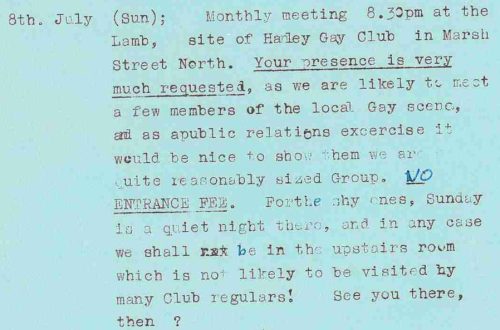
Above – from Stoke CHE Newsletter June 1973 – Hall Carpenter Archives HCA/CHE/7/141)
Transcription
8th. July (Sun); Monthly meeting 8.30pm at the Lamb, site of Hanley Gay Club in Marsh Street North. Your presence is very much requested, as we are likely to meet a few members of the local Gay scene, and as a public relations exercise it would be nice to show them we are a quite reasonably sized Group. NO ENTRANCE FEE. For the shy ones, Sunday is a quiet night there, and in any case we shall not be in the upstairs room which is not likely to be visited by many Club regulars! See you there, then ?
Finding a Home: From Living Rooms to Mame’s Bar
In its earliest days, the group was a “very small group of 5 people” meeting in private residences, such as Jerzy’s home in Loggerheads or “John’s place near Nantwich”. As the local gay scene developed, the group sought more public venues… following the opening of the One for One (141) Club on Marsh Street in May 1973, the group began holding monthly meetings there. These were typically held on the first Sunday of the month at 8:30 PM and the CHE newsletter encouraged members to attend as a “public relations exercise” to show the local scene they were a “quite reasonably sized Group”
Meetings at the club were not without controversy as the following letter illustrates:
I sympathise with your correspondent’s indignation (see July Newsletter – Ed!) regarding the lack of support at the Hanley Club, and feel that the gauntlet (or hand-bag!) should be firmly clouted around the ears of those members who cried out for a meeting to be held there and then failed to turn up. Those of us who treated the idea with some suspicion turned up to a man, only to be let down by the very people we were trying to oblige.
As the person who was probably the least interested in the Club as a meeting place, I am prepared to admit that I was wrong, and that the Club does offer many advantages. I am happy that the group now proposes to meet regularly, once a month, at the Club, although I do feel we should offer other attractions from time to time. If this doesn’t suit our some-time members – hard bloody luck!
(Letter to the editor in Stoke CHE Newsletter, Aug 1973 – Hall Carpenter Archives HCA/CHE/7/141)
In April 1974, the group established a permanent “headquarters” at the Vine Inn in Hanley where they were
given use of “Mame’s Bar”, which members redecorated themselves. . Meetings then shifted to a more frequent schedule, occurring on the first and third Wednesday of every month at 8:00 PM
CHE Meetings at the Vine
An article in Gay News Issue 46 published 9 May 1974 tells us about the group meeting at The Vine Inn…
Stoke-on-Trent CHE
STOKE-ON-TRENT: The local group of Campaign for Homosexual Equality reckon they have struck it lucky here in Stoke.
They now have a headquarters at the Vine Inn, Vine Street, Hanley, where they have been offered every facility by the landlord and landlady. They have been given the use of Mame’s Bar (named after the landlady) where there is a disco on Mondays, Tuesdays, Wednesdays and Thursdays. Besides the disco equipment, Mame’s Bar boasts a stage, a piano and a grand. Gay News is on sale there and the group feels that the general atmosphere is very friendly. The bar has been redecorated thanks to the generosity of ‘Rose’ (who Rose is they’re not letting on!) who bought the materials and has done most of the work.
There is also a telephone contact number now for Stoke CHE, and you can get up-to-date information by ringing John or Mike at 0782 (Stoke-on-Trent) 25596
(Gay News Issue 46 May 1974)

Article in Gay News Issue 46 May 1974
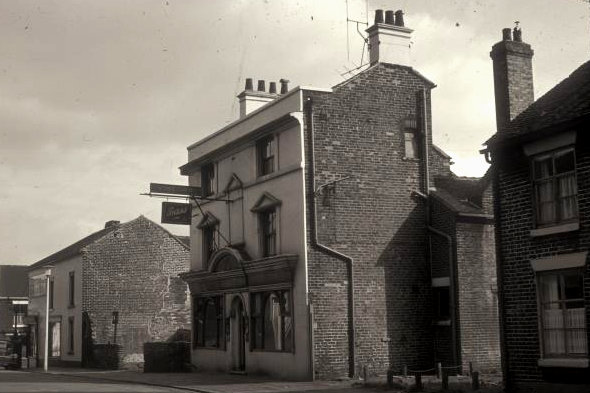
The Vine Inn was in Vine Street Hanley, no longer there as it was demolished a while ago
Social Life and Cultural Identity
The group functioned as much as a social club as a political one. Monday nights were dedicated to “Coffee Evenings”, alternating between Tony’s flat in Hanley and John’s cottage in Baddiley. Newsletters from 1973 and 1974 reveal a wide array of activities designed to build community:
- Rambles and Picnics: The group held successful picnics at the Roaches and organised an ambitious eight-mile walks along the sandstone trail to Beeston Castle, advising participants to bring “plenty of foot plasters”(October 6, 1974)
- Car Treasure Hunts: These popular events were judged on participation rather than speed, with prizes presented at a member’s house afterward
- Other outings: included visits to Bodnant Gardens
- Cultural Evenings: Members held “Musical Evenings”, though the March 1974 newsletter jokingly warned that attendees would be “assailed with John’s collection” of 101 obscure composers.
- 16mm Film Shows: The committee arranged screenings of films that were not generally released or were of specific interest, such as “Death in Venice” and “The Victim”.
- Fundraising Events: These included “Bring-and-Buy” sales, piano recitals by and sponsored walks where committee members would “walk, crawl or hobble” for group funds.
- Club of the Month: To keep the scene fresh, the group organised coach trips to other cities, such as visits to ‘La Chic’ Club in Nottingham and trips to Blackpool to see the lights and visit Pepe’s bar
- The Newsletter: The group’s bulletin was a vital link, featuring news, a diary of events, articles, poetry and satirical commentary on national politics. There was also plenty of fun such as “Gay Crosswords and a “Gay Cookery” column with recipes for things like Danish Apple Soup and Pommes Lyonnaise (May 1974).
Even political campaigning had a communal, energetic spirit. Members took pride in their leafletting campaigns, such as a 1973 trip to Wolverhampton where they distributed 600 leaflets. They were relieved to find “no nasty comments or hostility” and noted with satisfaction that the flyers “were all read!”. The group also engaged in serious political lobbying, such as inviting parliamentary candidates to the Vine Inn during the 1974 election to answer questions on gay rights.
From “Halloween Happenings” and Bonfire Parties to discussing the national Law Reform Bill, the Stoke-on-Trent CHE was a group that insisted on finding “Health, Wealth, Mirth and Wine” while fighting for equality!
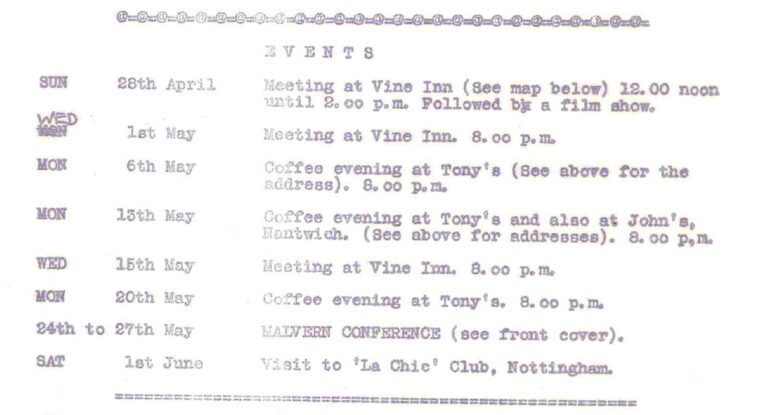
Diary of events from the Stoke CHE Newsletter May 1974 – Hall Carpenter Archives HCA/CHE/7/141)
Campaigning and Activism
The 1974 Malvern Conference: “The Gay Event of the Year”
In May 1974, members of the Stoke CHE group attended a joint national conference held by the Campaign for Homosexual Equality (CHE) and the Scottish Minority Group (SMG) held in Malvern, Wocestershire. It served as a critical platform for both political decision-making and social networking, drawing activists from across the UK to engage in a packed four-day programme of provocative speakers, workshops, and public meetings.
The conference was not merely a social outing; it was a decisive moment for the internal politics of the movement described in the Stoke CHE newsletter as “the Gay event of the year”. At a previous National Council meeting in Liverpool, it had been decided to carry forward several contentious recommendations to Malvern so that the members present could collectively decide on the future of the organisation. One of the “hot topics” of debate was the proposed increase in national membership subscriptions to £2.50. The Stoke-on-Trent group felt particularly strongly about this issue, having been one of only five groups to oppose the hike, fearing it would restrict membership to those who could afford it and exclude the out-of-work or elderly.
Despite the serious nature of the debates, the conference maintained a celebratory atmosphere. The event featured a variety of fringe events, a concert, and a “Disco & Dance”. Stoke members were encouraged to attend to ensure their voices were heard, with the newsletter warning that it would be “too late to complain afterwards” if they failed to represent their views. Registration was managed locally by the convenor, Tony Scurrah, for a fee of £1.
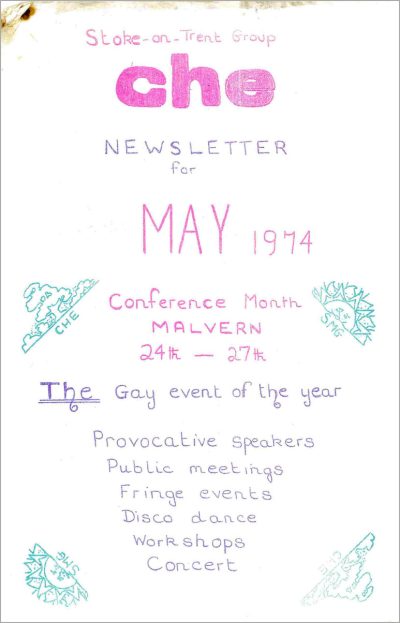
Stoke CHE Newsletter May 1974 – Hall Carpenter Archives HCA/CHE/7/141)
The 1974 London Rally: A Milestone for Local Activism
In late 1974, the Stoke-on-Trent CHE group turned its attention toward a major national political event: a National Rally in London held on November 2, 1974. This rally was a pivotal moment for the national movement, designed to demonstrate a “huge turn out” of gay people to show public support for a new Law Reform Bill that CHE intended to present to Parliament at the start of 1975. The group viewed this trip as essential for securing their “future legal rights,” specifically targeting the abolition of discriminatory laws like “Gross Indecency,” which at the time only applied to male homosexuals.
To ensure the Stoke-on-Trent group was well-represented, the committee took the ambitious and financially risky step of providing free transportation to London for all group members. This was a significant commitment for a local branch that had struggled with a “meagre bank balance” and recent losses on social events. The newsletter editor, John Cryer, captured the group’s nervous excitement and the financial strain of the undertaking with characteristic local humour: “Hope I don’t have to report that our Treasurer has leaped from the roof of the Vine in the next newsletter”.
Campaigning for Equality
The primary focus of the trip was the Law Reform Bill, which contained 19 sections aimed at achieving legal parity. Local members were briefed on the Bill’s key objectives, which included:
- Decriminalisation: Abolishing the criminal law of “Gross Indecency” and ensuring that acts between same-sex partners were only unlawful if they would also be unlawful for heterosexual couples.
- Legal Equality: An equal age of consent for heterosexual and homosexual sex
- Privacy Protections: Establishing a defence for “Public Indecency” if the accused had no reason to believe they would be seen by the public.
- Fairer Policing: Proposing that the evidence of a single police officer should not be sufficient for a “soliciting” charge.
“The Most Enormous Gay Disco”
Despite the serious political nature of the rally, the trip also featured a significant social element. The evening was capped off with a massive event that the local newsletter hoped would be “the most enormous gay disco ever held!”. This blend of bold political lobbying and vibrant social celebration was a hallmark of the era’s activism, allowing members from the Potteries to feel part of a powerful, visible national community after years of operating under the “fear and stigma” of the local climate.
This excursion to London represented the culmination of the Stoke group’s transition from small, private meetings in 1972 to becoming an organised, mobile force for civil rights by the mid-1970s.
Youth Rights and the Age of Consent
One of the most defining aspects of the Stoke-on-Trent CHE group’s work was its proactive stance on protecting and including young gay people. The group was a vocal supporter of the national Law Reform Bill, which CHE intended to present to Parliament in 1975 to replace the restrictive 1967 Act. A central objective of this Bill was the equalisation of the age of consent.
While national laws remained oppressive, the group took action to make their own community more inclusive. At a monthly meeting on 6 January 1974, the Stoke CHE group unanimously approved a motion to lower the minimum age for membership to 16. This decision was born from a belief that the movement should not “restrict membership to those who can afford it,” specifically advocating for the out-of-work and young people during a period of “galloping inflation”.
Defending Youths Against Police Hostility
The group’s advocacy for young people was often a direct response to the hostile local climate. During the “police purge” of 1972, activists reported that the police were “ostentatiously watching” the homes of local gay men and taking youths to the station for questioning “in the absence of solicitors, parents or guardians”. In response, the local movement (primarily through the Keele Gay Lib Soc) documented these “dubious police practices” and filed formal complaints with the National Council for Civil Liberties (NCCL) to ensure that the rights of young people were not being trampled by overzealous surveillance.
Education and Countering Stigma
The group’s newsletters often reflect a deep concern for how a lack of proper sex education affected young gay people. Many members had personally experienced a lack of school-based support and knew how “deeply it stigmatised vulnerable gay adolescents”. One newsletter occasionally featured a poem urging adults to “teach our children / The real scene” so they wouldn’t grow up believing their nature was inherently bad.
By providing a seat at the table for those as young as 16, the Stoke-on-Trent CHE sought to create a world where the next generation could grow up with visibility, support, and legal protection.

The characters featured in this cartoon in March 1974 also appear in other Stoke CHE newsletters. The depiction of young men may have been intentionally confrontational towards the attitudes of the time – Hall Carpenter Archives HCA/CHE/7/141)
Later Years
Keith Groom
Keith Groom officially became the primary contact for the Stoke-on-Trent CHE group in July 1976, although his leadership presence was documented as early as August 1975 when an “election broadsheet” was issued to members announcing the retirement of the previous convenor, Tony Scurrah, and it bore a signature identifiable as Keith’s.
While Michael Dawes continued to be listed as the public contact through June 1976, Keith’s name and address at Stoneyfields Court were officially listed in Gay News starting in July 1976. In May 1978, the listing was expanded to include Barbara Williamson as a joint contact alongside Keith in Gay News.
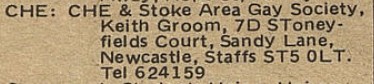
Listing in Gay News 28 July 1976 – the inclusion of Keith’s home address is speaks of his courageously unashamed out and proud personality
A major turning point occurred in June 1979 with the formation of the Potteries Gay Community Association (PGCA). Keith and the Stoke CHE were part of a nine-strong working party—alongside groups like Keele Gay Soc and the North Staffs Gay Switchboard – that established this new association to create a “greater local understanding of gay issues” and find a dedicated community space.
Stoke-on-Trent’s first Gay Centre opened at 3 Hillcrest Street in Hanley in April 1981. This centre provided a coffee bar, counselling services, and a home for the Switchboard, which Keith had also helped found.
As the PGCA and the new Gay Centre absorbed the community’s social and support needs, the original CHE group effectively wound down. By November 1982, records showed only one remaining member in the local CHE branch, and the group’s final listing appeared in Gay News in April 1983.
Despite the official dissolution of the CHE branch, Keith Groom remained a central pillar of the local community for decades. Keith is remembered as a “living history” of the post-1967 struggle, often described as “incredibly energetic,” “outrageous,” and unafraid to speak his mind. He continued his activism through the the North Staffordshire Gay Switchboard, and later as a trustee for Staffordshire Buddies, supporting those living with HIV/AIDS until his death in 2007. Read more about Keith’s life on this tribute page created by Maurice Greenham.
Nationally, the CHE has evolved into the CHE Research Trust (CHERT) a Charitable Incorporated Organisation (CIO) established to research and publish the history of LGBT rights in the UK. See www.chert.org.uk


Copyright Notice
News clippings in this post were compiled by Andrew Colclough from various archives as part of his personal research into local LGBT+ history and are shared here for educational purposes on the basis of fair personal/non commercial use. Copyright, where applicable, remains with the original publishers. Photographs are believed to be in the public domain and sources are credited where possible – please contact us if any further permissions or acknowledgments are required. All original text is © Andrew Colclough. Thank you!
Read and Submit Comments
If you can help us expand on this history please share your comments below!
Please send your comments and suggestions using the form at the bottom of this page. If you’d like to share photos, media, or additional information, please Contact Us. To prevent spam and malicious content, all comments are reviewed before being published. Any information you share may be used in articles on or website or in our community newsletters and other publications.
Thank you for your help – our history is important, lets make sure it’s not hidden or forgotten!