


Timeline of LGBT+ History for Stoke-on-Trent and Staffordshire
1979 – Potteries Gay Community Association
We would love to hear from anyone who can help us add to this post. Please share your memories using use the form at the bottom of this page or contact us.
Introduction
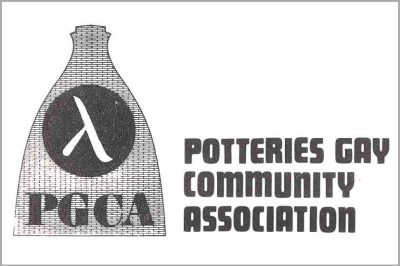
An edited version of the logo used on a letterhead in 1981
The Potteries Gay Community Association (PGCA) was launched in 1979, building upon the legacy of the national gay liberation movement that had gained momentum following the partial decriminalisation of homosexuality in 1967. Through meetings, newsletters, and public events, the PGCA provided support and social opportunities for local LGBT+ people, while also working to challenge the stigma they faced. The association was among the first of its kind outside the major UK metropolitan centres.
The PGCA described its mission as having two primary aims:
“To help gay people in whatever way we can” and
“To inform the community in general about gay rights and to win general support for full civil rights”
(PGCA Newsletter, October 1982)
The group successfully raised funds to open Stoke’s first gay centre, an incredible achievement for this period in our local LGBT+ history. Although the centre was only open for two years, the PGCA formed part of a wider set of community responses that helped lay the foundations for much of what came later.
The PGCA logo used in 1981 (above) features a bottle kiln representing the Potteries – an area that covers the six towns of Burslem, Fenton, Hanley, Longton, Tunstall and Stoke (which is now the city of Stoke-on-Trent) and the neighbouring areas of North Staffordshire. The lower case Greek letter lambda was declared the international symbol for gay and lesbian rights by the International Gay Rights Congress in Edinburgh, Scotland in 1974. It represents unity, balance, and the exchange of energy, a commitment to achieving equal rights through action.
1979 – Launch of the Potteries Gay Community Association
The PGCA was formed during a well-attended inaugural meeting on 11 June 1979 at Cartwright House in Hanley as reported in the following article published by Gay News.
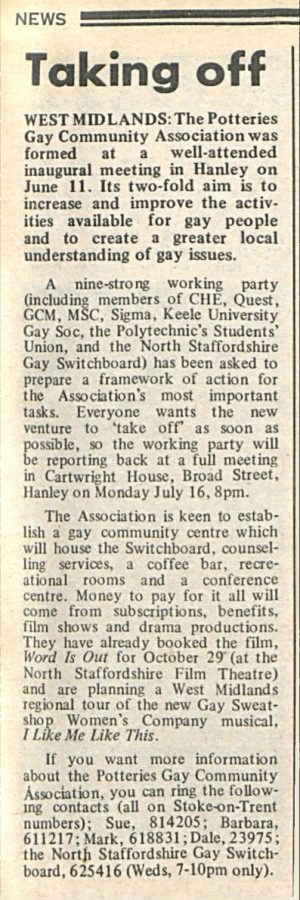
Gay News 28th June 1979
The following is a transcription of the above article published in Gay News, 28th June 1979
Taking off
WEST MIDLANDS: The Potteries Gay Community Association was formed at a well-attended inaugural meeting in Hanley on June 11. Its two-fold aim is to increase and improve the activities available for gay people and to create a greater local understanding of gay issues.
A nine-strong working party (including members of CHE, Quest, GCM, MSC, Sigma, Keele University Gay Soc, the Polytechnic’s Students’ Union, and the North Staffordshire Gay Switchboard) has been asked to prepare a framework of action for the Association’s most important tasks. Everyone wants the new venture to take off as soon as possible, so the working party will be reporting back at a full meeting in Cartwright House, Broad Street, Hanley on Monday July 16, 8pm.
The Association is keen to establish a gay community centre which will house the Switchboard, counselling services, a coffee bar, recreational rooms and a conference centre. Money to pay for it all will come from subscriptions, benefits, film shows and drama productions. They have already booked the film, Word Is Out for October 29 (at the North Staffordshire Film Theatre) and are planning a West Midlands regional tour of the new Gay Sweatshop Women’s Company musical, I Like Me Like This.
If you want more information about the Potteries Gay Community Association, you can ring the following contacts (all on Stoke-on-Trent numbers): Sue, 814205; Barbara, 611217; Mark, 618831; Dale, 23975; the North Staffordshire Gay Switchboard, 625416 (Weds, 7-10pm only).
Cartwright House
The venue of the inaugural meeting was Cartwright House in Broad Street, Hanley which housed the Hanley branch of the Workers’ Educational Association (WEA). The venue was used for adult education classes, meetings, and community groups. It was an annex adjoining the Mitchell Memorial Youth Theatre which still exists today behind what is now known as the Mitchell Arts Centre.
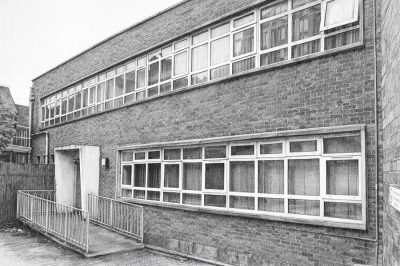
Cartwright House (image adapted from a recent photo)
Nine Strong Working Party
The above article refers to a nine strong working party, with members from the following eight organisations. It is likely that some of the nine people present were members of more than one of these community groups.
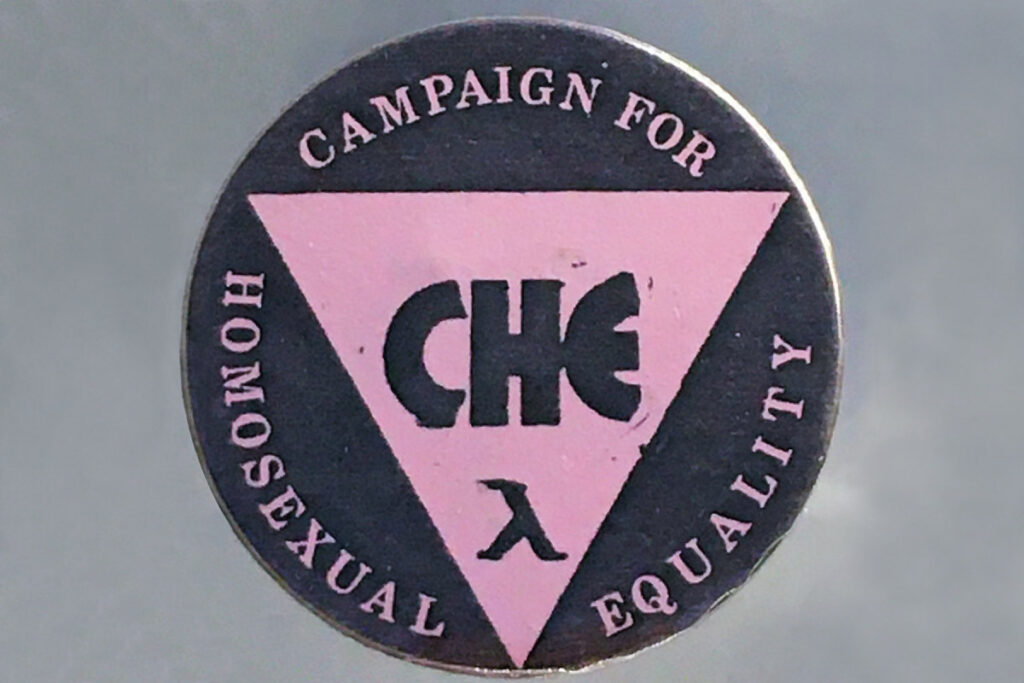
The Campaign for Homosexual Equality (CHE)
Stoke-on-Trent had a local Campaign for Homosexual Equality (CHE) group that was part of a national network of CHE groups that met across the UK. The goal of the CHE was to promote legal and social equality for lesbians, gay men and bisexuals. The group in Stoke formed in 1972. Read more…
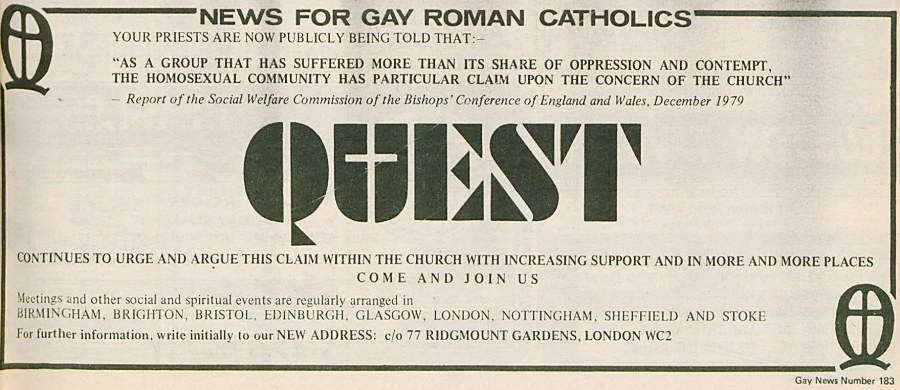
Quest
Quest was a national group that emerged in the 1970s to support gay (and later lesbian, bi, trans, etc.) Roman Catholics and to engage the Church on pastoral care. It built a national network of regional groups including meetings held in Stoke-on-Trent, the first having taken place in 1977.
Gay Christian Movement (GCM)
The national Gay Christian Movement was founded in April 1976 as an ecumenical (multi-denominational) fellowship and support organisation for gay Christians. A contact for Stoke appeared in Gay News soon afterwards. In1979 the contact listed in Gay News was well known community member and activist Keith Groom. The organisation was later known as LGCM (Lesbian and Gay Christian Movement) and more recently as OneBodyOneFaith.
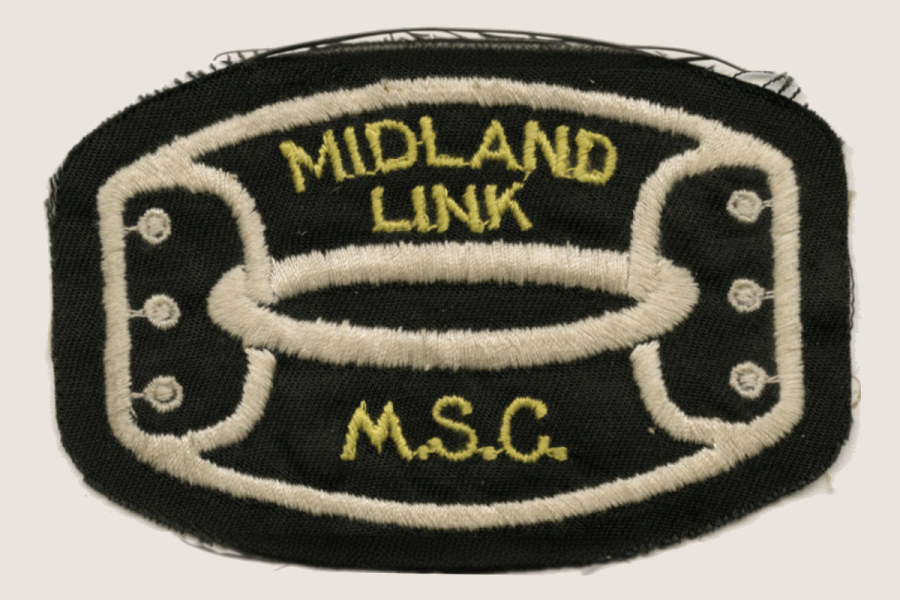
MSC
MSC (Motor Sports Club) was used as a discreet umbrella name for clubs formed by men into leather, uniforms, rubber, denim and fetish wear. Stoke did not have its own club but likely had members of Midland Link MSC which was founded in 1974 and was one of the longest established MSC clubs in the United Kingdom. The majority of its members lived in Birmingham and the surrounding areas,
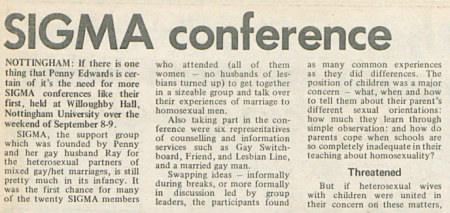
Sigma
SIGMA, was a national support group founded by Penny Edwands and her gay husband Ray for the heterosexual partners of mixed gay/heterosexual marriages. In 1979 they held their national conference in Nottingham (Gay News 20 September 1979)
Keele University Gay Soc
Students at Keele University formed a gay society in the 1970s, which was advertised in Gay News from 1978 onwards. Prior to this, Keele students had formed a Gay Liberation Society as early as 1972 Read more here…

North Staffordshire Polytechnic
Students at North Staffordshire Polytechnic formed a gay society which was advertised in Gay News from 1979 onwards – around the time that the Potteries Gay Community Association came together. A member of staff is known to have been involved in the local Campaign for Homosexual Equality much earlier than this.
North Staffs Gay Switchboard
The North Staffs Gay Switchboard was founded in 1977 at Keele University, the name was later updated to The North Staffordshire Lesbian, Gay and Bisexual Switchboard. Local community members who were not students also helped out as volunteers. Switchboard moved to Hanley City Centre in early 1980 and later moved into the gay centre established by the PGCA. Read more…

1979 – Knotty Action Ban Overturned
Early in its history, the PGCA and other groups successfully fought to lift a ban on gay organisations using the Knotty Action Resources Centre, winning a community vote 53–2
The Knotty Action Trust was a local registered charity that aimed to support local neighbourhood communities around Stoke-on-Trent. They opened an advice centre with a coffee bar at 4 Mollart Street in Hanley around May 1978. Mollart street no longer exists, it was in the area near Smithfield that is now part of the Potteries way.
In 1979 The North Staffs Gay Switchboard faced local opposition to their request to move into the Knotty Action centre. The ban was successfully overturned with the support of Peter Kent Baguley from the Potteries Gay Community Association, who had recently been elected to the Knotty committee at its annual meeting. Read more on on our post about the history of the The North Staffs Gay Switchboard
1980 – The Fundraising Campaign
By 1980, just a year after it formed, the fundraising campaign for a gay centre was already underway. Plans for the centre included a drop-in coffee bar, meeting rooms, space for counselling, and a home for the North Staffs Gay Switchboard — all things that were sorely missing from local life outside the commercial gay scene.
Peter Kent-Baguley was keen to stress that this was not a criticism of existing venues. “In fact, far from being rivals, the 141 Club, for example, has supported us fully from the beginning, offering a monthly benefit disco which has proved to be a major source of income for us” (quoted from Gay News, 4 September 1980).
To help reach their fundraising target, the PGCA came up with a great idea: supporters could “buy a brick” for £1 and receive a postcard “thank-you brick” in return. Appeals Co-ordinator Pat Booth explained, “People can boost our fund by buying a brick… Of course, we would love to have to send someone — lots of someones — a hundred bricks!” (quoted from Gay News, 4 September 1980).
Everyone who supported the appeal was promised a place in the PGCA’s special Gay Centre Pioneers Record Book, giving even small donations a sense of lasting contribution.
This early fundraising drive shows just how much vision, creativity, and community spirit existed in the Potteries LGBT+ scene at the time — and how determined people were to build a better, more connected future.
Support from the 141 Club
The 141 Club, located on Marsh Street in Hanley, was a vital ally to the Potteries Gay Community Association (PGCA) from its inception, providing the financial foundation necessary to open the city’s first Gay Centre.
The club provided a space for members to meet before the gay centre opened and significantly supported fundraising efforts by hosting monthly benefit discos. By 1981, these benefit discos were held regularly every 2nd Tuesday and 4th Sunday of the month, starting at 8:30 pm and all profits collected at the door during these benefit nights were donated directly to the Gay Centre Fund.
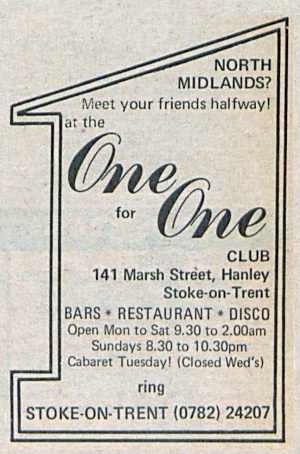
One for One Club Advertisement in Gay News 1975
Peter Kent-Baguley emphasized that the PGCA and the 141 Club were not rivals; rather, the commercial venue played a crucial role in supporting the association’s goal of providing a non-commercial alternative for the community. The proprietor of the club, Dave Morris (often referred to as “Mr 141”), demonstrated ongoing personal support for the PGCA’s cause. During the 141 Club’s 10th-anniversary celebration in March 1983, Morris enabled PGCA members to run a raffle during the festivities, which generated a £17 profit for the association.
While the management was supportive, the relationship with the club’s patrons was sometimes complex. Peter Kent-Baguley recalled that his political activism was not always welcomed by the 141 Club’s regular clientele. He noted that many gay people at the time preferred to remain “in their closet” and viewed campaigners as “dangerous”. On some occasions, when he attempted to distribute PGCA handouts, patrons would react with hostility, he recounted that some punters stuck PGCA leaflets to the wall with saliva to show their disdain.
Despite these internal community tensions, the 141 Club remained a steadfast institutional supporter until the PGCA’s Gay Centre was established.
Other Gay Scene Venues
The 141 club was not the only local scene venue that supported the PGCA. The White Swan in Hanley was a now largely forgotten gay venue quite close to Cartwright House where the PGCA held its first meetings. The October 1982 PGCA newsletter carried an advertisement for a weekly disco there on Wednesdays at 8pm
Also, the PGCA June 1983 newsletter mentions support from a long established gay friendly pub, The Antelope:
Many thanks to Ken & Tony at the ANTELOPE for letting our Treasurer CHRIS do a fund-raising card every Thursday.
FRIDAY JUNE 10th The ANTELOPE present The JOHNNY PEACH drag act with M.C. being our very own fabulous favourite WYNN ADLINGTON… 8.30pm.
1981 – The Gay Centre in Hillcrest Street
Less than two years after its launch, the PGCA had raised sufficient funds to take out a lease on suitable premises and Stoke-on-Trent’s first Gay Centre was opened at 3 Hillcrest Street in Hanley. The first listing of the Gay Centre appeared in Gay News in April 1981.
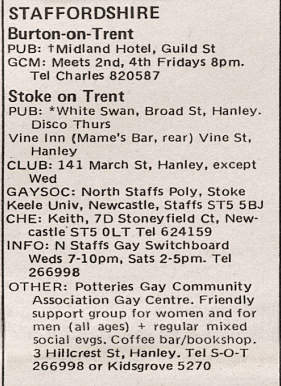
Gay News 16th April 1981
3 Hillcrest Street was near the junction with Bucknall New Road. The building was a terraced house between Thomas Shoe Repairs on the corner and the Pottery Workers Society Offices.
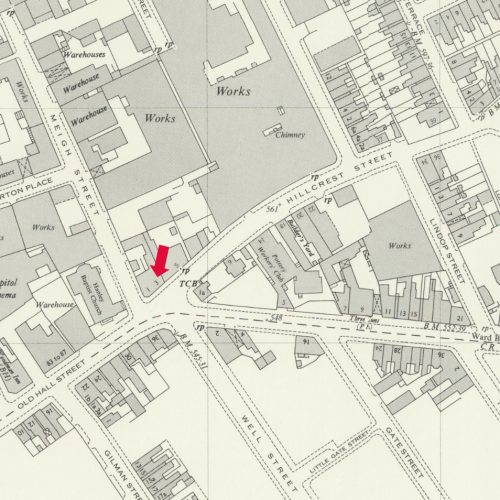
The Gay Centre was at No. 3 Hillcrest Street near the junction with Bucknall New Road (Map reproduced with permission of the National Library of Scotland)
A PGCA newsletter article described the significance of the gay centre as “an important symbol for countless gays who never visit it; it is a source of pride and security. It is also an important symbol for the whole community. It shows we exist, and it helps us in our efforts to gain credibility and acceptability. We know this to be true from what the many non-gay visitors have told us.” (PGCA Newsletter, Oct 1982)
North Staffs Gay Switchboard occupied an upstairs room at the back. A room downstairs was large enough for meetings and social activities. The centre was run entirely by community volunteers. (Source – conversation with Peter Kent-Baguley, Jan 2026).
PGCA Activities
The following transcription of an article from a PGCA newsletter published in 1982 summarises some of the things that PGCA did:
Since we started in June 1979 we have done a great deal on both fronts. The PGCA:
- provide a base & financial support for Gay Switchboard
- established special annual social events, eg Fancy Dress disco, May disco, regular parties etc.
- facilitated the Potteries’ first ever series of lesbian social evenings.
- established & developed a Gay Centre.
- brought gay drama groups to the Potteries.
Our efforts to reach out into the wider community have accelerated during 1982; look at the record:
JANUARY we showed the CHE slide kit and talked to the local Samaritan group.
FEBRUARY we launched the book written by gay teenagers, ‘Breaking The Silence’ to local Youth & Community workers.
MARCH our one hour programme was broadcast on Radio Stoke twice.
MAY we spoke to the Sixth Form at Cheslyn Hay Comprehensive School, Cannock, about homosexuality.
AUGUST we did a thirty minute phone-in about homosexuality on Radio Stoke.
SEPTEMBER we met members of the Stoke Voluntary Service Council about homosexuality and the PGCA.
1982 – Affiliation to the Council for Voluntary Services
In October 1982, the Potteries Gay Community Association Newsletter reported an important milestone for the group: the PGCA had finally been accepted by the Stoke-on-Trent Voluntary Service Council (VSC). After a long and sometimes frustrating process, the VSC Executive Committee approved the PGCA’s application at a meeting held on Monday 20 September 1982.
The application process had taken six months, something the PGCA saw as both a victory and a reminder of the challenges facing gay organisations at the time. As the article noted:
“The fact that it took six months for us to gain affiliation shows the tremendous amount of work that needs to be done in order that the rights of gay people are accepted as an ordinary fact of life.”
Unlike many other voluntary groups, the PGCA’s application was not straightforward. The group had not been allowed to simply complete the form and pay the £12 fee; instead, they had to wait until the VSC was satisfied that the PGCA was an “acceptable” organisation. During this period, the PGCA received valuable support from other groups, with organisations in Southend and Hastings writing letters to the Stoke VSC in support of the application.
On the afternoon of 20 September, Chris Harrison, Pat Booth and Peter Kent-Baguley met with the VSC Finance and General Purposes Sub-Committee to address concerns about the PGCA’s affiliation. The discussion was described as “frank and friendly,” but a major worry emerged: the fear that the City Council might disapprove of the PGCA and reduce its funding to the VSC as a result. The newsletter article described this as highlighting the need for the PGCA to build better links with local political organisations, particularly the City Labour Party.
Despite the constructive tone of the meeting, the PGCA representatives left feeling pessimistic about the outcome. The article recalls how morale was low later that day, making the eventual news even more powerful:
“When a member of the VSC Committee called at the Gay Centre that evening to deliver the good news you can imagine how uplifted we all felt.”
The successful affiliation was more than an administrative step. For the PGCA, it marked another landmark in their efforts to promote understanding and acceptance of gay rights within the wider local community.
1983 – The Gay Centre Closes
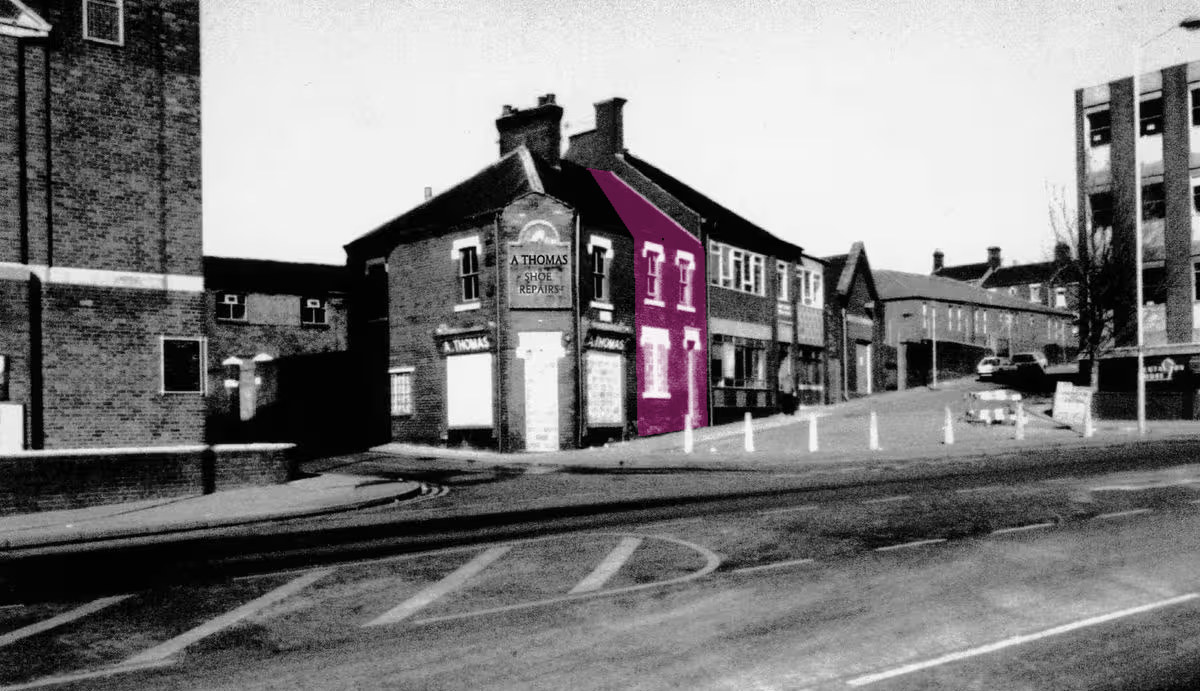
The end of Hillcrest Street in 1985 prior to demolition works. The Gay Centre is the terraced house highlighted in pink. (Adapted from a photo sent to the Evening Sentinel by Thomas Jones, of Meir)
Despite its successes, the Gay Centre faced financial strain and the threat of urban redevelopment. A “Grand Closing Party” was held on 23 July 1983, and the centre ceased operations that month. The building at Hillcrest Street was eventually demolished around 1986 to make way for the Potteries Way ring road. Photographs from 1985 show the building already abandoned, with doors and windows bricked up.
In a recent conversation with former member and chair Peter Kent Baguley, I asked whether the group had considered relocating the gay centre. He explained that by then the momentum had been lost, and they didn’t look for alternative premises. The North Staffs Gay Switchboard moved into the premises of the local CAB. Read more about Switchboard’s history here…
The Gay Centre last appeared in Gay News listings in March 1983. When Gay News was rebranded as Gay Times in May 1984 the “Potteries Gay Community Association” was no longer mentioned. However, later issues do carry listings in “local groups” for a “Potteries Gay Community” meeting at a local gay pub, the Star, in 1984 to 1985. The last listing is in 1986 which only offers a phone number and no venue.
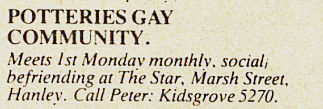
Gay Times May 1985
The need for a non commercial LGBT+ venue did not cease. In the late 1990s we had GMhap, later becoming The Piccadilly Project and in 2010 The Polari Lounge
Explore Local LGBT+ History


Copyright Notice
News clippings in this post were compiled by Andrew Colclough from various archives as part of his personal research into local LGBT+ history and are shared here for educational purposes on the basis of fair personal/non commercial use. Copyright, where applicable, remains with the original publishers. Photographs are believed to be in the public domain and sources are credited where possible – please contact us if any further permissions or acknowledgments are required. All original text is © Andrew Colclough. Thank you!
Read and Submit Comments
If you can help us expand on this history please share your comments below!
Please send your comments and suggestions using the form at the bottom of this page. If you’d like to share photos, media, or additional information, please Contact Us. To prevent spam and malicious content, all comments are reviewed before being published. Any information you share may be used in articles on or website or in our community newsletters and other publications.
Thank you for your help – our history is important, lets make sure it’s not hidden or forgotten!
This was beautiful Admin. Thank you for your reflections.